


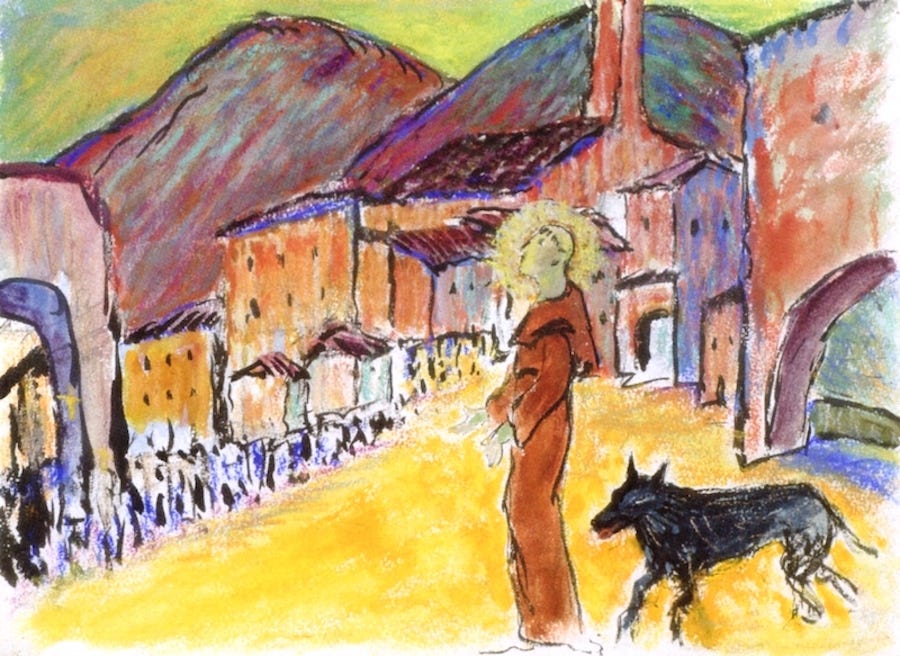
I’ve always been a “wolf girl.” The works of Jack London and Gary Paulsen proudly grace my bookshelves among wolf figurines and paintings. The Balto film soundtrack is among my most listened-to Spotify selections. So it’s no surprise that my favorite pious legend is Saint Francis of Assisi’s encounter with the wolf of Gubbio.
As the story goes, the wolf had been attacking livestock in this central Italian region for some time before setting its sight on human targets. Francis, feeling sympathy for the terrified citizens, resolved to settle the issue his way. Against the advice of everyone who knew his intentions, Francis walked unarmed to the wolf’s lair, where the creature waited for him, fangs out, ready to strike. Francis made the sign of the cross, invoking the wolf to “do no harm, in the name of Christ.” At the mention of the Savior’s name, the wolf became docile and sat at Francis’s feet. Francis rebuked the wolf for its ferocity, acknowledging the harm it had done to the people of Gubbio. But he also recognized that the wolf acted out of desperate hunger and arranged for the wolf to be fed by the people daily in exchange for mutual safety. The wolf agreed to these terms with a “paw-shake” and the people rejoiced.
On the surface, this is a straightforward story about peacemaking and sharing the redemptive love of Jesus. We also see this incident frequently described as “the time Francis of Assisi tamed a rabid wolf,” and it’s often sentimentalized in devotional art. But this is a story with layers, one that reveals uncomfortable truths about human nature and how we view creation: not as a gift of God, but as something to be subjugated at best and eliminated altogether at worst.
My husband and I own three cats. I knew absolutely nothing about cats when we first got together and found myself getting frustrated quite frequently at our oldest fur-baby’s antics. Why was he always getting into things he shouldn’t be? Why wouldn’t he listen when I told him no the first fifty times? Why did he always have to bite when he played? One day I got so angry and fed up that I started yelling (whether it was at my cat or my husband, I can’t recall). Once I was calm again, my husband sat me down and said something simple yet incredible: “Cats have their own rules. You have to operate on their level.” That was when I began really watching my cat, observing his body language and taking note of what times he was most active. I even watched a few videos on “cat psychology” and got input from vets and animal experts. Over time, being a cat-mom became easier. I had a better understanding of my cat’s behavior and how to “communicate” with him with my eyes and tone of voice.
Francis spent a lot of time in the wilderness before and during his ministry. It’s not difficult to imagine him observing animals from a distance and picking up on their behavioral patterns. Francis was known to preach the Gospel to animals, and he would have had to build some kind of rapport with them in order to do this. He wasn’t “taming” them; he was getting on their level to share the love of Christ that had changed his life so profoundly. Francis truly saw animals as his brothers and sisters, siblings who also had a share in God’s gift of creation.
God gave us dominion over creation in the book of Genesis. But in our brokenness we began to abuse this privilege. The Old Testament is full of stories of prideful kings who did great evil and brought destruction upon themselves and their people. Man, in his role of dominion over creation, is no exception. The poaching of animals, pollution, climate change, generative AI, and deforestation are all crimes committed in the misguided name of human progress and supremacy, crimes committed with no regard to their impact on future generations.
If Francis hadn’t intervened, I can only imagine the people of Gubbio would have made the same mistake as so many before and after them: indiscriminately killing every wolf in their path until the balance of nature was damaged beyond repair. Wolves are crucial to keeping herbivore populations in check and thus protecting human crops and precious vegetation. Francis knew, because of his past as a prisoner of war, that violence was not the answer, and so he approached the wolf without a weapon, symbolically ending the cycle of violence before exercising his dominion over the creature—not as a controlling lord, but as a humble steward.
Francis did more than just appease a beast and a frightened crowd that day. He also acknowledged what had caused the wolf attacks in the first place. Wolves have been shown to attack livestock only in cases when their regular food supplies (such as deer and rabbits) are low, another problem usually caused my human overconsumption. Hunger had driven the wolf into human territory, and its “crimes” were the result of desperation. Violence begets more violence. Francis knew the only peaceful solution was to tackle the problem at the source, and so he made sure the wolf was fed.
Death and ruin is a sentence our society has become too quick to dish out. We see it all the time on social media, where accountability for our words doesn’t seem to matter. “He should have complied.” “They should’ve come here legally.” “She shouldn’t have been drinking.” We rationalize violence, against nature and each other, to fulfill our own misguided sense of justice. As Catholic Christians we believe in a Savior who took on the skin of creation to die for us, a Savior who takes on the skin of creation at every Mass in the guise of bread and wine. It’s hard to think about that and not be ashamed of our bloodlust.
In an age of apathy, overconsumption, and normalized hatred, we are all being called to radical compassion more than ever. To feed the hungry and so cure their desperation, as Francis did. To speak out against physical and emotional violence when we see it. To strive for a world where we no longer die by the sword. To protect this beautiful world given to us by a God who is Love itself.
Radical compassion does not always look like activism or volunteering in soup kitchens. It actually begins with small acts of charity that pave the way for inner transformation, to paraphrase Saint Maximilian Kolbe (another Franciscan hero of mine). Sometimes it begins with a paw-shake. ♦
Stephanie C. Caporaso is a lifelong Connecticut resident, animal lover, and spiritual seeker. She currently resides with her husband, John, and three spoiled cats, Belushi, Molly, and Tina.