


From the time I was a young boy, I have had a visceral desire and passion for fairness and justice. This passion was intensified by my 11 years in the Jesuits, as I became increasingly aware of Jesus’s attitude toward wealth and the socioeconomic encyclicals of the magisterium, starting with Pope Leo XIII’s 1891 Rerum Novarum. I was blessed to obtain a PhD in economics from the University of Pennsylvania in 1968, specializing in economic development.
Starting in the 1980s, I saw and experienced a US Supreme Court and an economy structured to increasingly benefit the well-to-do, often at the expense of the less-than-well-to-do. This article outlines policies that I believe can reverse this trend and create a more equitable and just society in line with the tenets of Catholic social teaching.
Evidence of Growing Income and Wealth Inequality
The vast majority of Americans maintain the existing economy is not working for them. A Pew Research Center survey in September 2025 found that 74 percent of interviewees claimed that “economic conditions are only fair or poor,” while only 26 percent responded that “economic conditions are “excellent or good.”
The gap between the very well-to-do and most Americans has widened over the past 40 years, during both Republican and Democratic administrations. In 2024, the top 20 percent of households received 52 percent of all real income, up from 43.7 percent in 1970, while the lowest income group held only 3.1 percent, down from 4.1 percent in 1970. For lower-income households, 67 percent report living “paycheck to paycheck.”
The “American Dream” of owning one’s home is slipping away for many. According to the website Visual Capitalist, between 1995 and 2025, prices of houses increased 290 percent. Median housing prices for a two-bedroom house went from $82,800 in 1989 to $416,900 in 2025, an increase of 403 percent, while median household income increased from $23,620 in 1989 to $83,150 in 2025, an increase of 252 percent.
Union Membership
A basic principle of social justice is that the economy exists for the benefit of the people, not for the benefit of the state (as in Marxism) or for the benefit of the corporations, which is the case of unrestrained (or barely restrained) capitalism, wherein employers can treat their employees in almost any way they want to. Although corporations can have broad freedom in which to operate, their behavior is subject to the requirement to operate consistently with the common good, that is, to the benefit of society.
Growing income and wealth inequality has been accompanied by a decline in the percentage of union membership in the private (as opposed to the public) sector, from 34.2 percent in 1945 to 5.9 percent in 2024. Public-sector unionization has remained fairly stable over the last 40 years, fluctuating around 35 percent.
There has also been a steady decline of labor’s share of GDP (gross domestic product) compared to that of capital. In 1950, labor’s share of GDP was 62.8 percent; capital’s was 37.2 percent. In 2023, labor’s share had declined to 56.8 percent, while capital’s share had grown to 42.2 percent. In an economy that is working well, productivity and compensation are supposed to grow roughly equally. One explanation for this lack of equality is that starting around 1980, while labor’s contribution to growth in GDP was 1.4 percent, its compensation has only been 0.6 percent, less than half its contribution.
The Role of the Supreme Court in Growing Inequality
Recent decisions of the Supreme Court of the United States (SCOTUS) have been drivers of economic inequality. The Bipartisan Campaign Reform Act of 2002 (also known as the McCain-Feingold Act) imposed strict limits on how much one could contribute to a party or political candidate. This required transparency in donations. “Soft money”—that is, money raised or spent for the general promotion of a political party’s message—was prohibited, as were donations by corporations and unions.
This law was challenged by Citizens United v. Federal Election Commission in 2010. Five of the nine Supreme Court justices declared that parts of the McCain-Feingold Act were unconstitutional because they violated the free speech clause of the First Amendment. In other words, the government may not restrict political spending by corporations (or unions), and spending limits were invalidated. The result was huge increases in spending by wealthy donors. The perversity of the decision was that a human construct—a corporation—was put on the same level as a human person. The decision effectively removed people from deciding elections and let people with money effectively buy them. It made a representative democracy a plutocracy, rule by the rich.
In 2013, the decision in Shelby County v. Holder gutted the Voting Rights Act of 1965 by invalidating section 5, which required state and local governments which had election laws that racially discriminated to obtain preclearance from the US Department of Justice before implementation of any changes to their voting laws or practices. By this decision, the Supreme Court further weakened the US commitment to equality of all Americans. This exacerbated economic inequality because racial minorities have a more difficult time, due to voter suppression, in electing candidates who represent their interests. With the near-obliteration of section 2 of the voting Rights Act in the April 2026 decision in Louisiana v. Callais, it was made even more difficult for people of color to be elected, because they could legitimately be gerrymandered out unless it could be shown that newly gerrymandered districts were blatantly motivated by racism.
Union-Busting
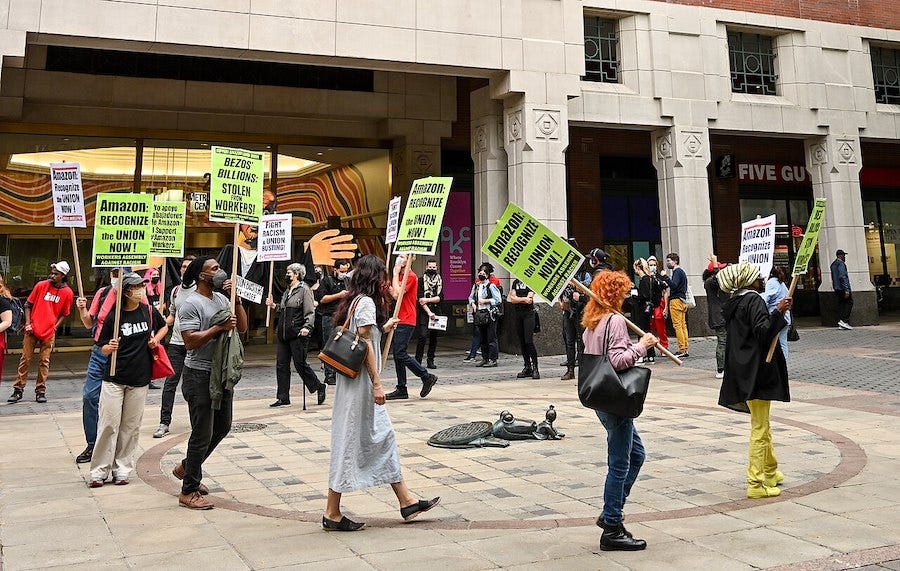
In spite of recent organizational activity, public support, and professed desire to belong to a union, the percentage of employees who are union members has declined from a high of 34.2 percent in 1945 to 9.9 percent in 2024. If we eliminate the union membership of the public sector—federal, state, and local government employees—at 32.2 percent, union membership in the private sector is around 5.9 percent of employees.
“Two intractable problems explain why union popularity, bargaining victories, and renewed labor activism haven’t translated into higher union density,” writes John Logan. He identifies these as “(1) disastrously weak labor laws and (2) ferocious corporate opposition to worker organizing.” Employers create a climate of fear and intimidation and wear down union supporters by stalling and delay tactics. Even if workers win a vote in an election sponsored by the National Labor Relations Board (NLRB), management files endless appeals such that the unions do not get their initial bargaining unit contract.
The NLRB does not have enforcement power. For enforcement it relies on the US federal court system, and therefore, is subject to the dilatory and other tactics of union-busters. Workers at Starbucks went over three years without a collective bargaining agreement, while those at Amazon went two years and nine months.
Other Factors of Economic Inequality
The last increase in in the minimum wage was in 2009, set at $7.25 per hour. The current minimum wage has one of its worst levels purchasing power since 1945; its greatest purchasing power was in the 1960s and early 1970s. The current federal minimum wage is a poverty wage. A number of states, counties, and cities have increased their minimum wage. A minimum wage of $15 would result in guaranteed annual income of around $27,660, for example.
Off-shoring of US jobs to other countries is another driver of inequality. It is estimated that 4.5 million US jobs have been lost through such “off-shoring” practices, with the manufacturing sector especially hard hit. Offshoring is abetted by the abuse of the H-1B visa program. The H-1B vasa was established to allow employers to hire foreign workers to fill jobs for which there were no Americans available. This provision has been poorly enforced.
Pay ratio is the ratio of total CEO compensation to the average (or median) worker’s pay. Total CEO compensation includes salary, bonuses, stock awards, and stock options. This ratio has ballooned since the 1980s. In 1965 CEOs made under 21 times the median compensation of the ordinary worker; in 2024, the ratio was a whopping 285 to 1. In 2024, when the median wage was $49,500 for all US workers, the average CEO took home $18.9 million.
Encouraging Unionization
One of the most effective ways to increase income and wealth equality is to enable and encourage unionization. An ordinary worker has no bargaining power with a large corporation regarding wages, benefits, and working conditions. The right to form and/or join a union is a civil right and a moral right.
In December 2025, private sector total compensation (wages/salaries and benefits) for union employees was $62.13 per hour compared to $44.78 for non-union employees, a difference of 41 percent. While the union employee base pay is always higher than that of the non-union employee, it is through benefits that the union employee is much better compensated.
To effectively counter the union-busting tactics employed by large corporations requires substantial improvement of the US’s very weak labor laws that these strong opponents of unionization break with impunity. This will require robust legislation and enforcement, the violation of which causes substantial economic and social pain to violators. It should be noted that the rights of labor to organize is fundamental to Catholic social teaching. Groups such as the Catholic Labor Network are reintroducing these resources to a new generation of Catholics and their allies.
Toward an Economy That Works for All
There are two types of corporate profit tax rates: the “nominal” rate, which had been 35 percent until Trump lowered it to 21 percent in 2020, and the “effective” rate, which is what corporations actually pay. From 1990 to 2000, the effective rate was around 30 percent; from 2020 to 2025, it fell to 12 percent. If the corporate profit nominal and effective rate was raised to 28 percent, it would yield over $1 trillion to be split between increased compensation of labor (which reduces the amount of corporate profits) and government.
In 2025 there were 902 billionaires in the US, holding approximately $6.8 trillion in wealth. There are 400 of the richest people in the US who have approximately $6.6 trillion in wealth. And in 2025 the wealthiest 400 increased their wealth by $1.2 trillion because of the surging stock market and AI. Given how the billionaires can influence public policy that make themselves even richer, and such influence hinders if not blocks the well-being of the vast majority of the population—think Trump’s “Big, Beautiful Bill”—it is appropriate to impose a “wealth tax” on billionaires.
The Supreme Court must restore spending limits on candidates and political parties. It is people who are supposed to elect their representatives, not money. People who have large amounts of money to, in effect, “buy” their representatives, enjoy unfair access and influence. From the standpoint of justice, no one person or small group should have such influence on public policy.
Other ways to create an economy that works or the vast majority of Americans include removing the abuse of the H-1B visas, applying a “transfer” fee of 10 to 20 percent on all stock buybacks, including workers’ representatives on corporate management committees, and imposing an annual wealth tax of 1 percent per billion dollars. If this tax were imposed on the $6.8 trillion of net assets of billionaires, it would raise $68 billion annually. ♦
Charles Gibson serves on the steering committee of Catholic Church Reform International. Interested readers can access the complete report from which this article is drawn here.