


Part I of this series, “Life Stories: Towards a Franciscan Renaissance,” is available here.
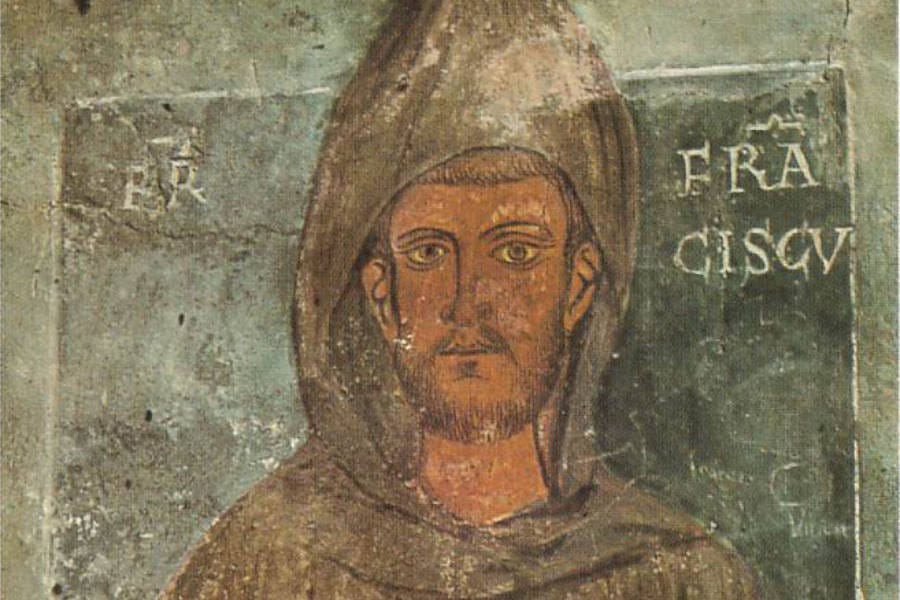
Saint Francis of Assisi is one of the most widely revered Catholic saints. It is not just within Catholicism that he is so honored: today there are orders of Lutheran Franciscans, Episcopalian Franciscans, and Ecumenical Franciscans. Mahatma Gandhi, a devout Hindu, had deep respect for Saint Francis. In 1952, an Indian writer and editor named Najoo Bilimoria wrote of a conference held in Perguia, Italy, four years after the death of Gandhi “to initiate a world-wide movement based on non-violence, love and service, the cardinal virtues embodied in the lives of both St. Francis of Assisi and of Gandhiji.” In the Muslim world, Saint Francis is known through his encounter with the Sultan Al-Kamal. Francis was deeply moved by Muslim religious practices, particularly the call to prayer, something that he later incorporated into the Franciscan rule.
Like many spiritual leaders and mystics, much has been written about the life of Saint Francis. He was canonized by Pope Gregory IX on July 16, 1228, just two years after his death. In 1229 Pope Gregory commissioned Thomas of Celano to write the saint’s biography. The church was in crisis at the time. There were increasing tensions with breakaway movements, which led to the Inquisition. Groups like the Waldensians were gaining power and followers in France. The Catholic Church was rife with corruption and inertia. The founder of the Waldensian movement, Peter Waldo, believed and preached that the gospel should be lived each day, while the church suggested that the faithful only read interpretations authorized by the hierarchy.
Pope Gregory recognized the value in lifting up the memory of Saint Francis and strengthening the growing Franciscan Order to counter the growing popularity of movements like the Waldensians. Gregory felt it was important that the biography of Saint Francis be written not so much as a historical document but as a guide to promoting spiritual renewal within the life of the church. In a period when the Crusades had failed and there was a power struggle between the papacy and the Holy Roman Empire, he understood that Saint Francis offered an alternative spirituality and a way of Christian living.
+
Saint Francis was born around 1182 in Assisi, Umbria, in central Italy. His father, Pietro, was a successful silk merchant and one of the more influential leaders in Assisi. His mother, Pica di Bourlemont, is believed to have descended from nobility in Provence, France. Pietro would often travel on business to France, which is where he was when Francis was born. Pica originally named him Giovanni di Bernardore, but Pietro renamed him Francesco.
Little is known about the saint’s early life. It is suggested that he had several siblings, and that his father hoped he would succeed him in running his very successful business. As a son of a wealth and privilege, Francis would have spent his days chasing after pleasure, eating the best food and wearing the finest clothes. Much to his father’s chagrin, he showed little interest in the family business. He was much more interested in spending time with the traveling troubadours and poets who made their way through Assisi.
While the young Francis certainly appeared to live the life of a carefree, wealthy youth, there are indications that he was searching for more. One such indication is told in the story of the beggar. In this story, Francis is working at his father’s shop selling cloth and velvet when a beggar arrives and asks for alms. At first, Francis chases him away. But later, perhaps out of guilt or a sense of compassion, he pursues the beggar and gives him all the money in his purse. Upon learning of his charitable behavior, his friends mock Francis and his father becomes very angry and scolds him.
There is very little known about Francis’s mother. Most of what we do know comes from the writings of Thomas of Celano. It is likely that she would have been familiar with the Waldensian movement, as she was from a part of France where it was active and growing. It has been suggested that she was sympathetic to the movement; if this is true, then she could have instilled some of its values and beliefs into the young Francis, which he later carried over in forming the Franciscan charism. It might also explain why he was so willing to include women like Clare as leaders of his movement—a revolutionary act at the time.
Francis grew up in an age saturated with stories of knights and heroes who joined the Crusades to free the Holy Land and to prevent the Muslims from killing Christians. It was also a time when Italy was divided into city-states that often warred against each other. As a young man, Francis would have been excited to prove his chivalry and honor. When he was twenty, Assisi went to war against its rival Perugia. Francis enlisted in the military to seek his fame and glory. Given that he was the son of a wealthy town leader, he was afforded all the proper accessories of war, including a horse.
Neither the army of Assisi nor Francis fared very well. The Perugian army overwhelmed the Assisians, and many were slaughtered. Because he went on horseback, Francis would have been identified as being from a wealthy family. Instead of being massacred, he was captured and held for ransom. He was held in a dark subterranean cell for a year, until his father paid his ransom. He returned to Assisi in his early twenties a shell of his former self, suffering severe physical and mental trauma from the imprisonment. Today he probably would be diagnosed with PTSD.
Upon returning home, Francis attempted to reconnect with his former life. He went back to work in his father’s business and attempted to rekindle relationships with his friends. But he was lost. Both his physical body and his spiritual soul were broken. He was a young man with no sense of direction or purpose. As Thomas of Celano wrote in his biography: “When he had recovered a little, he began to walk about through the house with the support of a cane . . . [and] one day, he went outside and began to gaze upon the surrounding countryside. But the beauty of the fields, the delight of the vineyards and whatever else was beautiful to see, could offer him no delight at all [and he] considered those who loved these things quite foolish.”
He continued in this state of depression for a few years. In 1205, the city-state of Assisi again began preparing for war. With the help of his father, Francis once more acquired the necessary armaments and horse. He seemed to rise out of his depression and find a renewed sense of direction. One can imagine that he felt this time he would earn his knighthood and make his father proud. He would finally find the purpose and meaning that he had been searching for.
+
There are several versions of what happened next. Most are centered around the idea that Francis had a vision or dream. Whatever it was, it convinced him to abandon his thoughts of becoming a glorious knight. He returned to Assisi with no firm direction, only a vision. He met with the Catholic bishop Guido. What was said at that meeting is lost to history, but it must have had some effect. Several years later, Guido became a benefactor of the Franciscan movement and help it to secure approval from Rome.
Francis took to wandering the forests and uninhabited countryside. On one of his wanderings, he stumbled across the abandoned chapel of San Damiano, just outside of Assisi. He started staying there in the evenings. One evening he had the famous vision of God telling him to “rebuild my church.” He first thought that God was telling him to rebuild the physical structure of San Damiano, as it was then in serious disrepair, so he began gathering stones to try and reconstruct the church.
After a few months Francis returned to Assisi, looking so emaciated and unkempt because of his fasting that the townsfolks declared him to be insane. His father captured him and locked him up for a few days. After a week or so, his father left for a business trip and his mother released him. Francis went back to San Damiano and continued his life of poverty. In Thomas of Celano’s account, he came to the town center, stripped all his clothes, and renounced all claims to his father and his money. Bishop Guido then wrapped his episcopal mantle around Francis, allowing the young man to take on the role of a penitent under his protection. Whether this version of the story is accurate, or perhaps a combination of different legends, one thing is certain: this was the moment when Francis’s transformation began. He went from a broken, lost, and empty spirit to one who knew and understood the Divine within him.
Bishop Guido granted Francis the use of the chapel at San Damiano. He began to work among the lepers near Assisi. Soon others started to join him. The first was Bernard of Quintavalle, son of one of the richest, most noble men in Assisi. Many others followed, some rich and some poor. They saw the transformation and peace in Francis and wanted to share in it.
One early follower was named Ruffino. He and his cousin, Clare, came from a wealthy family in Assisi. Ruffino gave up everything to join Francis. Clare observed the change in her cousin: how, since joining Francis, he seemed more at peace and closer to God. She decided she wanted to learn more. She asked Ruffino to set up a meeting with Francis. At first Francis refused. His community was exclusively male at the time. He suggested that if Clare was seeking religious life, she should join one of the cloistered orders of women that were close by. In one of the many instances when she would refuse to accept the idea, common at the time, that women could not be strong, powerful leaders and equals, Clare said no. She insisted that God was calling her to be partners with Francis. Francis finally relented and allowed her to join the brothers. Thus began the movement we now know as the Franciscans.
Patrick Carolan is a Catholic activist, organizer, and writer. He served as the Executive director of the Franciscan Action Network for ten years; he co-founded the Global Catholic Climate Movement and Catholics Vote Common Good. His writing and activism are centered on his understanding and belief through Franciscan spirituality of the connectedness of all creation and God.