


A Migrant’s Trail
She’s knocking on the door of light one more time,
and one more time it opens only to darkness.
There are shadows lying across the land,
but she knows the desert has two faces,
the terror of death and the treasures of life.
A migrant’s trail, where a smile is a jewel,
a meal, a miracle, a safe place to sleep, heaven on earth.
Yes, the desert has two faces, she’s seen them both.
The terror of death and the treasures of life.
She knows all too well the trail of cruelty,
and the trail of love,
and where moments of kindness can turn into a last instant.
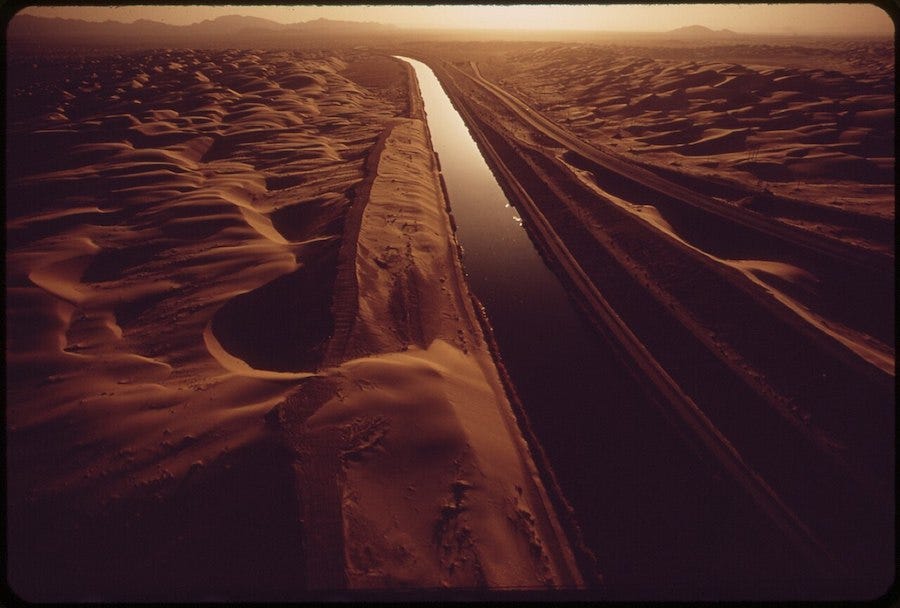
I wonder if she drowned in the irrigation canal.
Only “Jane Doe” and a row number mark the red brick of her pauper’s grave.
A privacy fence stretching hundreds of yards posts NO TRESPASSING,
where for uncounted migrants, death hits a wall.
Yet it is strewn with flowers, some fresh and alive,
others wilted and dead.
It does something to you, weeping at the edge of this field.
In sackcloth, you cross over a deep sadness, a loneliness, to a gentle presence:
God the Great Solitaire.
And from our first moment to our last instant,
the desert closes us down and breaks us open
to the terror of death and the treasures of life.
The Child King
Ramon puts feet over head with the ease of a butterfly.
He and his father are up from Honduras,
fleeing terror and looking for work to pick our fruit,
A million cartwheels away from home.
Grandfather was killed for denouncing corruption,
Father is next in line.
No time to lose, lives packed in knapsacks and plastic bags,
should have been gone yesterday.
They find refuge for three days in Mexico.
A meal and rest and then papa continues weaving paracord through the handles of plastic milk jugs,
fitting them to Ramon’s tiny waist.
With each twist and cinch, eyes knot in fear.
Neither knows how to swim.
No chance for asylum,
They prepare to cross the All American Canal.
At seven, Ramon is old enough to know he has no home,
and young enough to upright an upside down world,
spinning cartwheels.
“Watch me, watch me, here I am.”
Innocence calling to innocence.
All things new, floating across the All American Canal.
This will be their third attempt to reach the fields.
Fields that feed thousands in a valley called Imperial.
On their second try, over the wall and across the canal,
they make it all the way up to Interstate 8.
Hiding in a gully, the Border Patrol spots the boy and calls him out, “Amigito, salgas de alla.”
“Weez no espeakid espanish herz,” he answers.
Out of the gully, he spins a cartwheel, and asks for water.
The agent kindly obliges and then drops them back to Mexico.
Tomorrow they’ll try again. After that I hear nothing.
Camping at Drop 3 on The All American Canal, a blue ribbon of water
drops over turbines to illuminate this valley called Imperial,
and then flows on to irrigate its fields.
A slight breeze splashes through branches of salt cedars.
Roots dive to drink. Deep calls to deep.
Green feathery leaves, white flowers blooming all around.
I imagine Ramon spinning cartwheels and his father picking our fruit.
Oranges spin the color of sunrises, plumbs the color of sunsets.
Crowns of fire burning for justice, proclaiming the greatest gift of all.
A child’s heart big enough to hold everything anyone could ever feel and love,
Peace on Earth.
Maryknoll Lay Missioner Richard Dixon serves in El Salvador. “A Migrant's Trail” was originally published by Maryknoll Magazine.