


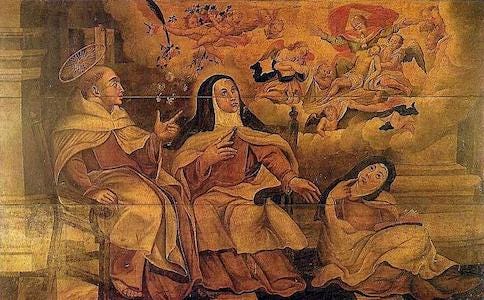
Overshadowed by the plenary assembly of the United States Conference of Catholic Bishops this week was a Vatican-hosted event of note: the “Mysticism, Mystical Phenomena, and Holiness” conference organized by the Dicastery for the Causes of Saints and held from November 10 to 13.
Vatican News and the Catholic News Service reported on Pope Leo XVI’s remarks at the event on Thursday, where the Holy Father defined mysticism as “an experience that transcends mere rational knowledge, not because of the merit of those who experience it, but because of a spiritual gift that can manifest itself in different ways.” The presence of mystical phenomena such as visions or apparitions is not in itself a sign of holiness, which can only be discerned by a person’s “complete and constant conformity to the will of God,” he said.
In an article in Italian, Vatican News provided more detailed coverage of the event, including excerpts from presentations on Jewish, Islamic Sufi, and Hindu conceptions of mysticism. In speaking of the latter, Fr. Benedict Kanakappally, professor at the faculty of missiology of the Pontifical Urban University, made the connection between the poetry of the Hindu Āḷvārs and biblical texts like the Song of Songs.
Fr. Kanakappally also drew on the Spiritual Canticle of St. John of the Cross—a felicitous choice, given that Pope Leo would go on to quote St. John’s great soul-friend, St. Teresa of Avilà, as a means of reinforcing the distinction between sensory phenomena and the true experience of mysticism: “The highest perfection obviously does not consist in interior delights or in great raptures or in visions or in the spirit of prophecy but in having our will so much in conformity with God’s will that there is nothing we know he wills that we do not want with all our desire, and in accepting the bitter as happily as we do the delightful when we know that his majesty desires it.”
St. Teresa’s clarification of “the highest perfection” reminded me of the comment of another mystic closer to our own time. When asked how he discerned between authentic mystical experience and psychosis or projection, Br. Wayne Teasdale cited the traditional criterion of Matthew 7:16: “By their fruits you shall know them.”
“There isn’t a disassociation” in mystical experience as there is in cases of psychosis, Br. Teasdale elaborated. Rather, “there is a clarity and a certitude and a fruit that comes from [authentic mystical experience].”
Br. Teasdale’s comments rhyme with those of Pope Leo at the Vatican conference, when he stated that mystical experience bears fruit for the whole church, “the mystical Body of Christ,” and is not simply a mark of “individual privilege.” This unifying force is how we recognize the unique gifts of the saints: by “listening to their reputation for holiness and examining their perfect virtue, as expressions of ecclesial communion and intimate union with God.”
+
I’m pleased to share a feature article and a reflection available this month at U.S. Catholic. The feature is a profile of St. Columba’s Inverness, an Episcopal Church and Retreat House in West Marin, California, that is doing pathbreaking work at the intersection of parish and monastic life. Those who are concerned about parish decline in the Catholic Church might find in St. Columba’s one model of reaching others through contemplative spirituality—“laying the table with the delicacies of the patristic tradition,” as one interviewee put it. The reflection, available in both text and video format, is on this Sunday’s gospel.
Michael Centore
Editor, Today’s American Catholic
Love this inspirational note which otherwise would have gone unnoticed by me. Thank you Michael!