


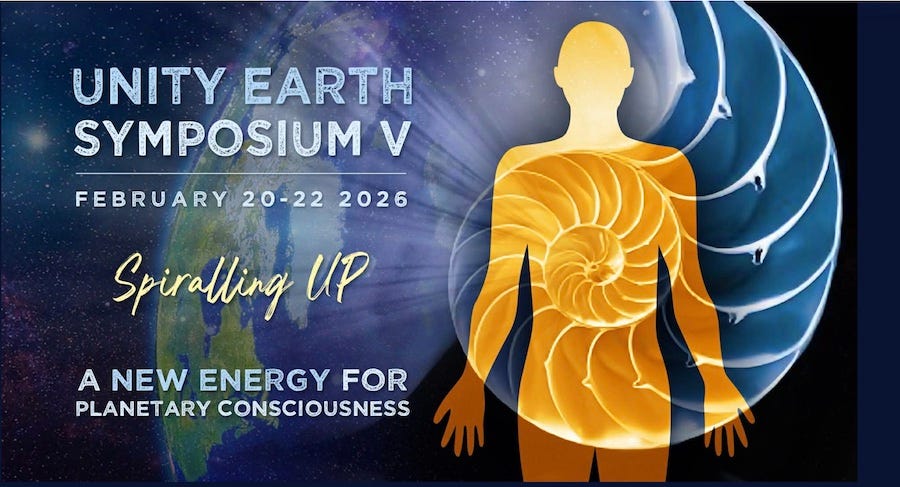
“Someday, after mastering the winds, the waves, the tides and gravity, we shall harness for God the energies of love, and then, for a second time in the history of the world, man will have discovered fire.”
This prophetic call from Teilhard de Chardin was invoked by multiple speakers during the Unity Earth Symposium held this past weekend. The annual global gathering brought together cultural leaders and peacebuilders, spiritual practitioners and interfaith leaders, and a range of artists, poets, scholars, and thinkers for two days of shared dialogue and inquiry around themes of collective responsibility, interspiritual wisdom, and the evolution of human consciousness.
Described as “both a contemplative space and a catalytic forum,” the three-day online event was convened by Unity Earth, an international network dedicated to the realization of peace on earth through multicultural, multi-continental, and interreligious programs and activities.
This was the fifth annual symposium facilitated by Unity Earth, which is celebrating its tenth anniversary this year. The theme for this year’s gathering was “Spiralling Up: A New Energy for Planetary Consciousness.”
Several presenters drew on the image of the spiral as an evolutionary symbol. Irina Morrison, vice president of Unity Earth Australia, said in her opening remarks during an introductory session on Friday, February 20, “A spiral acknowledges that while we may pass the same points of challenge and growth, we do so from a higher point of view.” In a prayer offered later that evening, Dr. Joni Carley spoke of the “great mysterious source of the spiralic dance of life.”
Sacred Portals
Though not officially broadcast as part of the symposium, the February 20 session offered a background and history of Unity Earth as well as testimonies and observations on the purpose of the organization from team members, friends, and affiliates.
Executive director Ben Bowler gave a brief overview of the inception of Unity Earth and its key events over the years, such as its celebration of World Interfaith Harmony Week in Ethiopia in 2018. He described Unity Earth alternately as a platform, an ideal, an organization, and a community before adding, “mostly, it’s a promise.”
Bowler recognized Teilhard as one of the organization’s “patron saints” and “someone who really spoke into love as the ultimate creative force of the universe.”
Unity Earth associate Kurt Johnson shared that several symposium participants were also contributors to the two-volume Interspirituality collection published last year by Light on Light Press. He pointed to Unity Earth as working in a “transformative direction” and said that the group is dedicated to building structures that can facilitate transformation.
Team member Rev. Deborah Moldow recalled the launch of Unity Earth at the Tillman Interfaith Chapel at the United Nations in New York in October 2016. A visit with Bowler to the nearby Ralph Bunche Park, where the words of Isaiah 2:4 (“They shall beat their swords into plowshares . . .”) are incised into a wall, became “an unshakeable foundation” for the spiritual vision of Unity Earth, she said.
Bowler introduced a series of speakers who addressed what they saw as the significance and potential of this historical moment and the ways in which Unity Earth can continue to deepen its mission.
For author Jeff Vander Clute, Unity Earth “has consistently been luminous and has consistently sounded the note of unity.” Clute said that he believes humanity “is in the tail end of the outgoing paradigm” that is based on “the defended sense of self and identity” and is “shifting into harmony and planetary consciousness.”
Unity Earth brings “convergence of those on the more contemplative path and those on the more activist path,” he said, adding that “the outer is the deepest inner and the inner is the deepest outer.”
As part of a panel with Fumi Johns Stewart and Michael Lindfield, educator Dot Maver amplified the idea of Unity Earth as “a global community answering a call” to “shift from separateness to unity.”
Lindfield appealed to a “consummation of this inner marriage between the cosmos and our own inner divinity.”
“The one life is everywhere and all embracing” and yet is inside of everything, he continued. He linked this to the distinction between the immanence and transcendence of God.
Among Friday’s presenters was Peter Blaze Corcoran, professor emeritus of Florida Gulf Coast University and founder of the Center for Environmental and Sustainability Education.
Corcoran has worked with the Vatican’s Dicastery for Promoting Integral Human Development around issues related to climate change and Laudato Si’ and has represented Unity Earth at a United Nations environmental assembly. As part of his remarks, he displayed a slide of Pope Leo blessing a Greenlandic iceberg during an international conference celebrating the tenth anniversary of Laudato Si’ in 2025.
Also on Friday, Olivia Hansen of the Spiritual Life television channel announced Unity Earth as the winner of the 2026 Oneness of Humanity Award, which is accompanied by a $25,000 grant. In expressing his gratitude for the award, Bowler called it “a seal of encouragement” for the organization.
Coworkers with the Universe
Saturday’s presentations were dedicated to partnerships, coalitions, and alliances. A morning session featured leaders from various traditions who spoke about their experiences of peacebuilding across cultures and the ways in which cooperative networks are essential for developing a planetary consciousness.
Participants regrouped in the afternoon for “Alliances of the Heart: Networks for a Shared Global Future.” Panelists from organizations including the International Academy for Multicultural Cooperation and the Global Security Institute explored how coalitions can influence governmental policy and steer structural change. [TAC was unable to cover Day 2 due to previous commitment, but complete recordings are available here—Ed.]
Sunday’s sessions began with “The Future of Interspirituality: From Awareness to Action.” Interspirituality is a term coined by Catholic monk Br. Wayne Teasdale to describe “the common heritage of humankind’s spiritual wisdom” shared across the world’s religions.
In his opening keynote, Rev. Matthew Fox identified two recent events as having demonstrated a spiritual commitment to justice: the culmination of the Buddhist monks’ peace march from Houston, Texas, to Washington, DC, and the protests in Minneapolis against state violence and kidnapping.
Fox said that “recovering the sense of the sacred is foundational to our future as a species.” He held up self-described “geologian” Thomas Berry’s teaching that the universe itself is our primary sacred reality.
Science is a part of “deep ecumenism” and interspirituality, he said, noting, “We are being continually blessed by today’s science.” He added that one major challenge of the moment is the need “to move beyond the anthropocentrism that has marked so much of the modern era.”
In his elaborations on the theme of “the sacredness of our work,” Fox quoted Thomas Aquinas (“To live well is to work well”) and Meister Eckhart (“The outward work can never be small if the inward work is great”).
“Our work is community work,” he continued. “We are coworkers with the universe, we are coworkers with the Christ, with the Buddha, with Saint Francis, with Hildegard [of Bingen], with Sr. Dorothy Stang.”
Principles of Correspondence
Fox’s keynote was followed by three “converging clusters” of panelists who shared their vision of how spirituality transforms the world in which we live.
Cluster 1, hosted by the Bede Griffiths Trust, was facilitated by Rev. Dr. Matthew M. Cobb. Cobb shared how the “spoken word” is one way of understanding interspirituality. He reminded listeners that the Gospel of John is rooted in a single spoken word.
“It’s only one word that you’re seeking with your heart,” he said. “That cosmic blessing is coming through all of us through spoken word.”
Panelist Roger Briggs traced the history of humanity’s first cities, which he said were “peaceful partnership cultures.” The emergence of the first civilizations 5,000 years ago introduced hierarchical societies with markers of a “domination culture” such as walls, weaponry, and the practice of slavery, he said.
Today we are seeing “the last gasps of the domination culture,” he observed. “This is really the time of coming together” and recognizing “the oneness, the unity of all the wisdom traditions.”
In a separate segment, Bowler shared a song from Ghanaian musician Rocky Dawuni and invited him to address the symposium.
“I always came to the realization that the first temple is nature,” Dawuni said. “Man was put in a garden because the garden is where we connect with God.”
Dawuni described nature as “the interface for us to be in touch with God” and the ways we care for creation as “the building blocks of interspirituality.”
“We can’t deceive the universe,” he said.
Cluster 2 was sponsored by the Temple of Understanding and was moderated by its director of advocacy, Grove Harris.
“We are looking for what is transformative, not simply performative,” Harris said in her introductions.
She highlighted “respect for differences” as a key part of the work of the Temple of Understanding. “We need to be present and active, but with our own particular kind of flavor,” she said.
Panelist Jonathan Granoff, president of the Global Security Institute, spoke of the need to bring love into the affairs of human beings.
“The duty of our actions is to ensure an enabling environment” where the “beauty of the soul can be expressed,” he said.
Granoff shared some of the Global Security Institute’s practical initiatives, including its collaborative efforts with the World Academy of Art and Science on the global campaign Human Security for All.
“We have made nations to serve us,” Grandoff continued, yet they “are not being held to what we in our heart know is possible.” He offered what he termed a “Golden Rule for the 21st century”: “Treat the lives and well-being of future generations as we want to be treated.”
The final cluster focused on “prosocial spirituality” and was moderated by Jeff Genung, managing director of ProSocial World.
Panelist Rev. Diane Berke said that a key aim of prosocial spirituality is to cultivate contemplative qualities and integrate them with behavioral science and evolutionary biology for the “thriving of the whole of life.”
Interspirituality is the overarching framework for prosocial spirituality, Berke said. She defined interspirituality as an “experience of the unitive ground of being” and a “direct realization of the interconnectedness of all that is.”
Author and physicist William Keepin presented a series of slides on the concept of the holomovement, or what he termed “the science of cosmic interbeing.”
He described reality as having a “fractal” or holographic structure, where each individual component is a replica of the whole. He shared an image of a Romanesco broccoli to illustrate this concept, pointing out how every nodule is a complete expression of the entire flower.
Consciousness itself has a fractal structure, he said, meaning that “the full infinity of divinity is within you.”
Pattern Persistence
Two additional clusters rounded out the symposium on Sunday evening. The first, “From Dialogue to Embodiment: Interspiritual Action in a Divided World,” brought together panelists affiliated with the United Religions Initiative (URI), including founding executive director Rev. Charles Gibbs.
“What burns in me is helping the voices not often heard,” Gibbs said. He expressed a need to “help the rest of the world listen a little better.”

Moderator Sally Mahé, a senior advisor at URI, touched on an image germane to the Catholic Church’s ongoing movement towards synodality when she spoke of the symbolic power of the circle and the importance of “round tables” during organizational gatherings. Panelist Kay Lindahl also spoke in the language of synodality when she described listening as “a sacred art and a spiritual practice.”
For Gard Jameson, who chairs one of URI’s “cooperation circles,” a 1999 meeting with Teasdale in South Africa was a formative influence on his spirituality. He was introduced then to the African term Ubuntu, “I am because we are.”
The final cluster, hosted by the Charis Foundation, was facilitated by Charis co-founder and executive director Rory McEntee.
McEntee, a student of Teasdale and the Trappist monk Fr. Thomas Keating, opened with a brief overview of the Snowmass interreligious dialogues that Keating began convening in 1984. The Charis Foundation has continued these dialogues and will be holding their tenth this summer.
Panelist Alejandra Warden is the director of Charis Circles, small interspiritual practice communities that gather throughout the US and are expanding into Europe and Latin America. She shared how people from different traditions and walks of life come together in these Charis Circles for meditation and spiritual practice.
Younger spiritual practitioners want to know more about different religious traditions, she said. One intention of Charis Circles is “to show how a beloved community can be experienced.”
McEntee also spoke about Charis’s dual focus on interspirituality and the discovery of “new structures that can support a spiritual journey,” including new forms of monastic life. This “new monasticism” seeks to maintain a “total commitment to transformation” within the world of human relationships, he explained.
“We need a lot of people in the world who are living lives that can lead to the deepest kinds of transformations and potentials that we have as human beings,” he said.
Keepin returned with the Rev. Cynthia Brix to discuss the work of their organization, the Satyana Institute, as well as the Dawn of Interspirituality conferences that they co-direct.
Keepin recalled Keating’s influence and described the monk’s focus as bringing religions together in “a shared quest for the absolute.” He added that he once told Keating, “You are truly Catholic.”
“What does Catholic mean?” Keepin explained. “It means universal.”
The symposium concluded with a prayer of commission from Yanni Maniates and final remarks from Robert Atkinson, both noted authors and teachers.
“We’re forging a path for what is coming: a universal spirituality,” Atkinson said. “The characteristics that we find in a universal spirituality may already exist in the patterns of nature.”
He used the metaphor of an underground mycelial network that links the life of a forest to imagine an organically connected and interdependent humanity.
The mycelial network “doesn’t get distracted by what is breaking down” but “focuses on building up what is emerging,” he said.
“I’d like to invite us all to think of humanity as its own mycelial network,” he said. “Our equivalent of mycelial networks in the social world is renewing and recreating the entire infrastructure of social relationships upon a new foundation of universal harmony and unity.” ♦
Michael Centore is the editor of Tomorrow’s American Catholic.
Thank you Michael for your beautiful and timely article on the Unity Earth Symposium and congratulations to Ben Bowler and Unity Earth on your 5th annual programs and 10th anniversary. I especially appreciated how you captured the gathering as both a contemplative space and a catalytic forum—rooted in interspiritual wisdom, yet oriented toward practical cooperation and planetary responsibility. Your use of Teilhard de Chardin’s image of “harnessing the energies of love,” along with the spiral metaphor of revisiting challenges from a higher point of view, offered a clear and inspiring through-line.
I had invited a number of colleagues and friends to attend the two-day event, and your article encapsulates the essence of what many of us experienced: a shared movement from awareness to action, from dialogue to embodiment, and toward new forms of community and collaboration that can support peace on Earth.
Would you grant me permission to share your article (along with the great news that the recordings are freely available at https://unity.earth/tv/ ) with several individuals I invited to attend? If you prefer, I can share it only as a link, include full attribution exactly as you request, and add any brief note or disclaimer you’d like.
With gratitude,
Charles Betterton
livingearthmovement1@gmail.com