


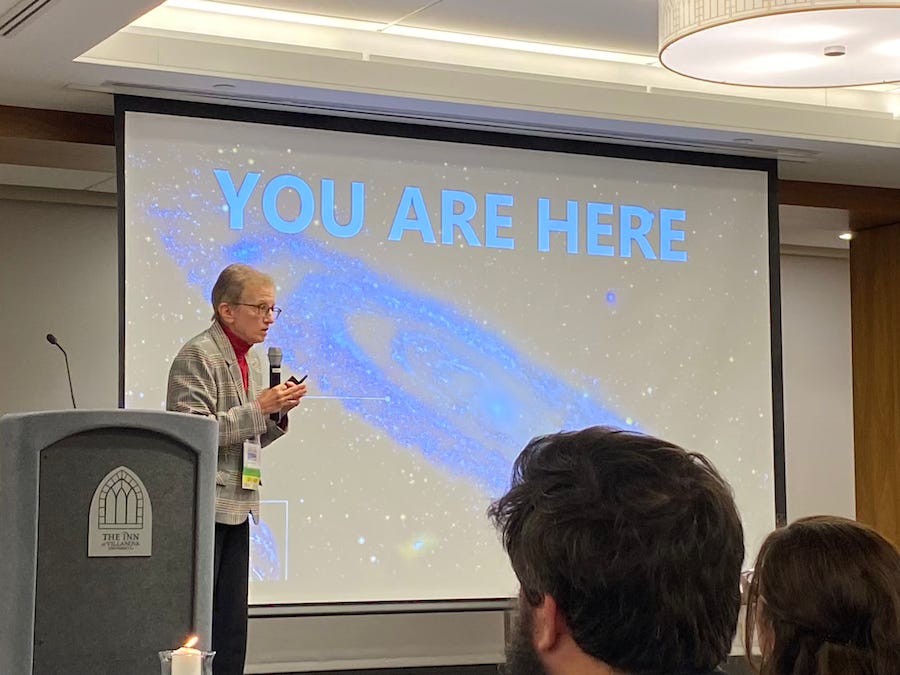
In her opening keynote for the World Institute for Science, Religion, and Culture (WISR) conference on Monday evening, Franciscan Sister Ilia Delio spoke of “the deep fracture in the human condition today” and outlined ways of healing it based on the teachings of Teilhard de Chardin.
She characterized the subject of her talk, “Love and the Indestructible in Teilhard de Chardin,” as “the lure of love.” She stated her intended goal was to take listeners into “a more cosmic view of love in the light of the world in which we’re living in today.”
She began by identifying a current “crisis of separation” of spirit from matter, mind from body, and masculine from feminine principles in the world, along with a “crisis of human energy.”
This crisis of separation has its origins in the beginnings of monotheism, when in discovering the one God humans began to look outside of themselves, she said.
Modern science brought with it the conquering of the physical universe, and “every time we conquer something we start to control it,” she noted. God was then “pushed out” by a domineering humankind as an unnecessary hypothesis.
Adding to this crisis were the ideas of philosopher Rene Descartes, who located his certainty in his thinking self and thus separated “the mental world from the physical world.”
The split in modern science continued as humans began to build a world of “stuff” that lured them away from their reflective selves, Delio explained.
She named three “guides” to help navigate this modern split of the mind: Carl Jung, who identified the division between consciousness and the unconscious; Iain McGilchrist, who has written of “the left hemispheric coup” whereby the analytical, linear left brain has overtaken the creative, holistic right brain in human thought; and Antonio Damasio, who speaks of “the disembodied self” and calls humanity back to “the primacy of feeling as the root of knowing itself.”
McGilchrist describes a “meta-crisis” where the embodied self is cut off from the senses and locked into linear thinking. This leads to conditions of alienation, mental health epidemics, ecological destruction, and an imbalance in thinking, Delio said.
“We are a very successful half-brained people,” she continued. This imbalance is the root cause of the “polycrisis” humanity is currently facing, which manifests in “a disenchanted earth,” polarization and division, and “a fracture of relationship” within ourselves and with each other.
“We know a lot about the world but we don’t know how to belong to it,” Delio said. Because humans no longer have “a participatory way of knowing” and their knowledge is based on mastery over the environment rather than intuiting our unity with it, “we don’t know what it’s like to be alive.”
The left-brain dominance of human culture leads to a quest for power. Humans want to acquire more and more and endlessly perfect themselves, and yet “we never arrive,” she said.
“We are not to master life,” she said. “We are, in a sense, to be swept up in its embrace.”
Citing the work of Kristin Kobes Du Mez, Delio said that patriarchal ideals of masculinity have overpowered Christian virtues of compassion and love. Technology, too, can fall into the paradigm of dominance, as humans see it as a way to “reclaim and surpass” the fallen Adam.
To counter these trends, we must ask “what holds us together” in an era of fractured stories, Delio said. The question “What are we doing here?” is “where Teilhard’s story really begins,” she added.
She quoted Chardin as a way of framing her remarks: “If we are to see ourselves completely and survive, it must be as part of humanity, with humanity as part of life, and life as part of the universe.”
Delio introduced the image of “deep history” and reminded listeners that “we are a species in evolution.”
She briefly explored the possibilities of quantum physics to “open up a whole new discussion” around human relationality and the undivided wholeness of the universe. Citing David Bohm, she explained that consciousness is “a fundamental aspect of cosmic life” and that matter and consciousness are inseparable.
Building on this, she said that Chardin saw mind and matter as “two aspects of one reality.” He also described “an interiority to every aspect of matter.”
“The whole of mystery lies in matter,” she said.
She identified the two movements of love in Chardin’s thought: the tangential, that links outward; and the radial, that unifies and pulls inward.
“Love is a phenomenon of radial energy” in Chardin’s view, she said, noting that it is a cosmic phenomenon before it is a human phenomenon.
She described love as an “attraction that unites beings from within” and a “force that’s moving matter itself” toward something centered and relational. This implies that “all of nature is loving” because it is pulled toward a unitive, relational self, she added.
Delio examined Chardin’s concept of Omega as “a real, personal, already-actual center, immanent yet transcendent.” Omega is a principle of uncreated love that is within everything and yet is more than everything, not dependent on physical life and yet the “centrating presence” in every aspect of physical life.
“Love is inexhaustible, incomprehensible energy that brings together, draws life into more life,” she continued. Against humanity’s tendency to “[make] knowledge the source of power” while reducing love to an emotion, Chardin’s teachings demonstrate that “we seek knowledge to deepen love.”
This seeking after knowledge resonates with his idea that “the feminine”—the concept of eternal wisdom, or Sophia—“leads us into the masculine,” and that Christ is the wisdom of God (cf. 1 Cor 1:24).
Chardin’s work opens up to “a vital presence of love” that doubles as “an invitation to respond to love,” Delio said. Love sets us on a “limitless journey” into the universe and into ourselves. She again quoted Chardin: “I am the single radiance by which all this is aroused and within which it is vibrant.”
If we feel ourselves worn down today, it is because we have failed to tend to the energy within that is “calling [us] towards a unitive, relational life,” Delio said. Love is “the hope built into the universe” that draws us onward.
The fact that humans are pulled in so many directions, with fractured sense of time and an overload of information, means that it is hard to do the proper interior work necessary to respond to the creative power of love.
“There is something that is pulling us along, and that’s what we don’t pay sufficient attention to,” she said.
Delio argued that humans have made the objects of their love too small. “We have shrunk love to fit our size,” she said. The love that is drawing us into more love “is what the name of God is about.”
“The call to live in love is not optional,” she said. “It is vital to the survival not only of our lives as humans but to the whole of the planet.” ♦
Michael Centore is the editor of Tomorrow’s American Catholic.