

"Remembering, Journeying Together, and Protecting"
Newsletter for February 6, 2026

Scroll down for our latest offerings this week, including:
Perhaps one of the last issues that can transcend culture wars and political polarization is the threat of nuclear annihilation. The buildup of nuclear arms endangers all of us, in every part of the globe, a kind of dark mirror revealing the interconnectedness of humankind.
This is why the lapsing of the New Strategic Arms Reduction Treaty, or New START, on Thursday was so concerning. New START was the last remaining nuclear arms control treaty to place limitations on the world’s two largest nuclear powers, the United States and Russia. It followed on previous agreements signed by both countries in the early 1990s and renewed in 2011 by Presidents Barack Obama and Dmitry Medvedev.
“The urgency is hard to overstate,” the Quincy Institute for Responsible Statecraft warned in a brief about the treaty. “If [New START] lapses without arrangements to continue the application of its core provisions while buying time for negotiating a successor, the door opens to an unconstrained nuclear arms race at precisely the moment when global nuclear risks are already dangerously elevated.”
Writing for the Quincy Institute’s Responsible Statecraft website, Vermont Senator Peter Welch underscored the gravity of the issue: “A single use of a tactical nuclear weapon, either by accident or design, could trigger a flurry of escalating responses with far more powerful strategic weapons that would cause incalculable loss of life, widespread radiation poisoning, and destruction on a scale unlike anything seen in human history.”
Welch’s Senate colleague Ed Markey focused on the $10 trillion the US government spent to build more than 30,000 nuclear weapons at the height of the arms race in an op-ed for the Guardian. Speaking to the trans-partisan nature of nuclear disarmament, he cited one poll showing 91 percent of Americans in favor of negotiating a new agreement with Russia to either maintain current limits on nuclear weapons or further reduce both countries’ stockpiles.
That New START was allowed to lapse was not for lack of advocacy on the part of faith-based organizations. In January, over 40 communities, including several Catholic groups, signed a letter calling on Congress to publicly affirm the value of arms control, encourage the current administration to begin immediate negotiations on a New START agreement, and support diplomatic efforts with Russia and other nuclear powers to reduce global risk.
Among the signatories were several chapters of the Catholic organization Pax Christi USA. The organization’s communications director, Judy Coode, said via email that Pax Christi “has always prioritized nuclear disarmament” and called nuclear weapons “an existential threat to creation.” Resources spent on them “have stolen money from every other life-giving program,” she added.
Coode referenced Pope Francis’s remarks in his message for the First Meeting of States Parties to the Treaty on the Prohibition of Nuclear Weapons (TPNW) in 2022: “The use of nuclear weapons, as well as their mere possession, is immoral.” The idea of mutual deterrence, the pope said at the time, “inevitably ends up poisoning relationships between peoples and obstructing any possible form of real dialogue.”
Also in January, the Partnership for a World without Nuclear Weapons (PWNW) issued a statement in recognition of the fifth anniversary of the entry into force of the TPNW. PWNW describes itself as a “voluntary partnership, based on the principles of Remembering, Journeying Together, and Protecting.” It is an international organization comprising four founding Catholic (arch)dioceses—Santa Fe, New Mexico; Seattle, Washington; Hiroshima, Japan; and Nagasaki, Japan—as well as an international network of affiliates.
As of December 2025, 74 states have ratified or acceded to the TPNW, though none of the nuclear-armed states have thus far supported it. The Norwegian organization Nuclear Weapons Ban Monitor observes, “[I]t is largely . . . the nuclear-armed states and nuclear umbrella states that stand in the way of progress towards universalisation of the TPNW and agreement on nuclear disarmament.”
The PWNW statement places a special responsibility on these states, writing: “The nuclear-armed states have a moral obligation to hear the voices of the majority of the world, and to listen to those who face the threat of annihilation due to the reckless decisions of any one of their nine leaders.”
Groups like Pax Christi and PWNW remind us that the work of nuclear disarmament cannot be consigned to state entities, but must be a vital task of the church as well. With its global reach and its ability to express an ethic of sacramentality, solidarity, and universal human dignity, the church is uniquely positioned to be a leader in the movement for disarmament—a movement that encompasses racial justice, public health, and care for creation, among other life issues.
Coode summarized this calling forcefully: “Catholic individuals and organizations must condemn the gross misuse of funds for nuclear weapons and the antagonism that is fomented through the arms race. We are called to be peacemakers and to embrace nonviolence; it is impossible to promote peace and weapons simultaneously.”
Michael Centore
Editor, Tomorrow’s American Catholic
We Need to Protect Each Other
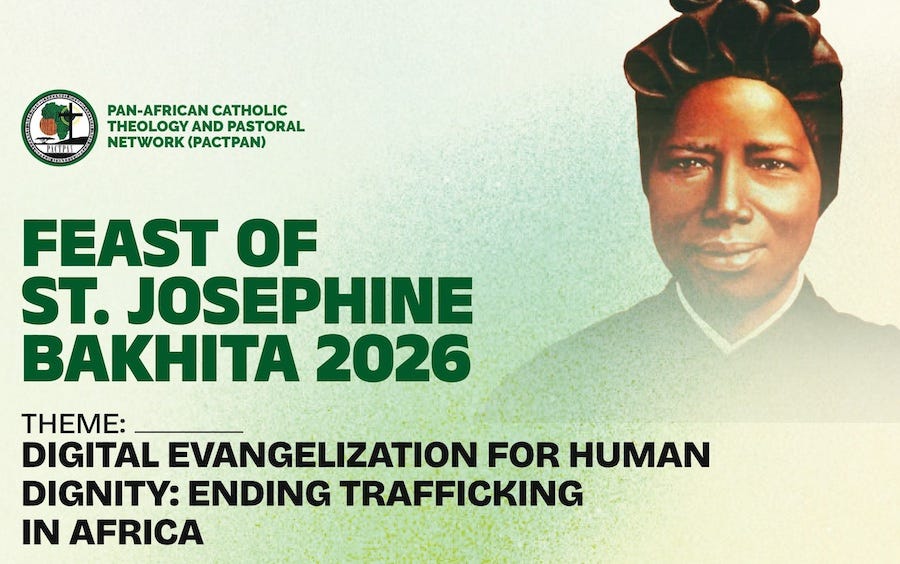
Sr. Leonida Katunge is a St. Joseph Sister from the region of Mombasa, Kenya. She is a theologian and a civil lawyer with extensive experience in academia, pastoral ministry, and human rights advocacy. She holds a Ph.D. and a master’s degree in sacred liturgy from the Pontifical Athenaeum of St. Anslem in Rome, a bachelor’s degree in theology, a Master of Laws, a Bachelor of Laws, and a diploma in civil law. She has served for over a decade as a professor of sacred liturgy at the Catholic University of Eastern Africa and currently teaches at Ancilla College and Marian University in Indiana.
In this episode, we speak with Sr. Leonida along with her colleagues from the Pan-African Catholic Theology and Pastoral Network (PACTPAN)—Sr. Miriam Chise of Zambia, Justin Giningakpio of South Sudan, and Fr. Cornelius Uchenna Okeke of the Archdiocese of Detroit—about the work they are doing individually and collectively to end the scourge of human trafficking. Our conversation was recorded a few days in advance of the International Day of Prayer and Awareness against Human Trafficking on February 8, the feast day of the Sudanese Canossian sister St. Josephine Bakhita.
Listen here »
What It Sounds Like

Rosemary Peters-Hill on grieving, hoping, and acting together in the wake of tragedies in Minneapolis: “Our lives are not our own, St. Paul tells us—a verse that seems particularly apropos in the Twin Cities context. It’s a concept that resonates across time. David Mitchell’s 2004 novel Cloud Atlas, about the interconnectedness of past, present, and future subjectivities and selves, echoes First Corinthians: ‘Our lives are not our own. We are bound to others, past and present, and by each crime and every kindness, we birth our future.’”
Read more »
Peace Outreach

Ray Temmerman on returning to the pre-Covid sign of peace: “I ask church leaders to let people throughout their diocese know that expressing our peace through physical contact is once again acceptable. I would recommend going further, and encourage it as a truly human expression of who we are.”
Read more »
Notes and Events
The Guild for Spiritual Guidance is hosting a discussion of the acclaimed film Flow (2024), directed by Gints Zilbalodis, on February 15 from 6:30 to 8:00 p.m. ET. This Golden Globe and Academy Award-winning animation takes viewers on a journey through realms natural and mystical. The discussion will be hosted by Jean Blackie, Bernice Marie-Daly, and previous TAC contributor Leslye Colvin. Registration and additional information is available here.
Rooted in the South African context, Alan Storey is a Gospel storyteller and facilitator of personal and political change. His presentation for the Association of Pittsburgh Priests on March 3 at 12:00 p.m. ET will focus on an interpretation of Micah’s summary of faith and how Jesus of Nazareth lived it out. A discussion rooted in lessons learned from the struggle for justice in South Africa and how these may be relevant for the world today will follow. Registration and additional information is available here.
On March 17 from 7:00 to 8:30 p.m. ET, the Center for Christogenesis will welcome the Rev. Dr. Hillary Raining for a live webinar, “Trauma, Transformation, and Christ-wholeness.” Together, participants will explore “the intersection of faith, tradition, and intergenerational trauma,” with special emphasis on the Indigenous connection to evolutionary spirituality. Participants will also consider the Christian mystical tradition as a spiritual and integral framework for healing and transformation. Registration and additional information is available here.
There are several events featuring authors from the two-volume Interspirituality series that we discussed with Kurt Johnson on the horizon; this newsletter compiles events for the upcoming month, and includes information on the Unity Earth Symposium from February 20 to 22.