


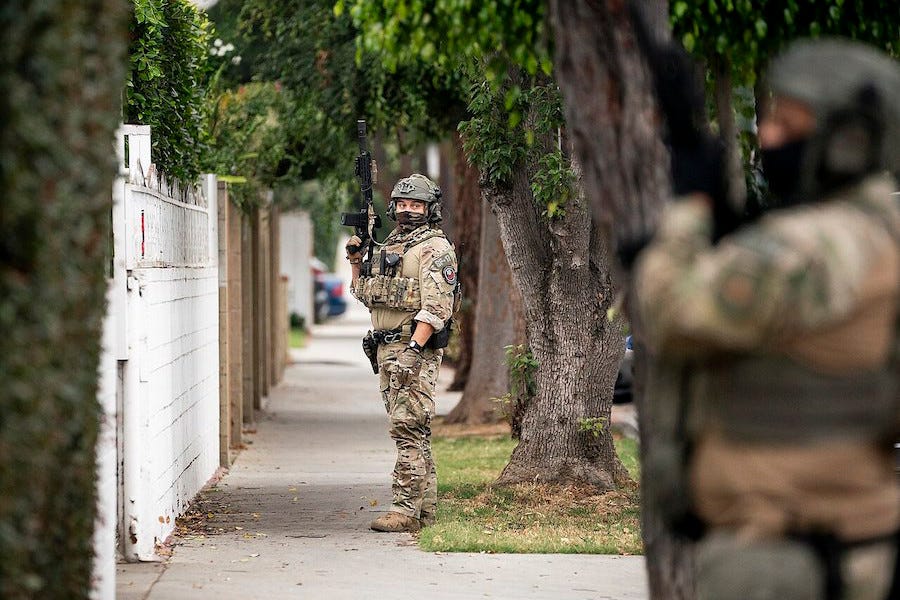
If you read one thing this week, I might recommend Kaira Jewel Lingo’s “Love Letter to an ICE Agent,” published to her newsletter on January 13.
Kaira Jewel is a Dharma teacher and was for 15 years a nun at the Plum Village (Buddhist) Monastery in France, founded by Thầy Thích Nhất Hạnh. Her letter is based on an exercise Thầy gave his students to write “a love letter to a suicide bomber” as a means of trying to understand that “those who cause great harm are also suffering greatly themselves, and that we must look deeply to understand the roots of the situation.”
I confess that I was emotionally jarred by the premise of the exercise—jarred, I would imagine, in the same way Jesus’s listeners were when he exhorted them to love their enemies. People are being terrorized and even killed. Is this the time to seek understanding, to lean into ideas of interbeing?
But Kaira Jewel makes clear that “this is not to excuse or enable the deeply immoral behavior of some ICE agents that we have heard so much about in the past year (and beyond), but to invite us to dig deeper.” She offers five guiding points as a premise to her letter: 1) recognizing the agent’s motivations; 2) letting them know we care and are connected; 3) seeing that they are caught in systems and structures; 4) pointing out the contradictions in their actions; and 5) letting them know we will be here if they choose to shift. On this last point, she quotes something Reverend C. T. Vivian once advised activist Loretta Ross: “When you ask people to give up hate, you need to be there for them when they do.”
Kaira Jewel then offers her own attempt at such a letter. As a commentary on the chaotic state of our country, sown of violence and division and mutual distrust, it is effective precisely because it is addressed to one person. It begins with a recognition of shared humanity and the complexities of human decision-making, including the decision to join something like ICE: “I imagine you as an adult navigating a country that has often felt unstable and morally confusing. I imagine the pull toward work that offered structure, dignity, purpose, and a way to protect something you love. I can understand why law enforcement, and even ICE, might have felt like a place to stand when so much else felt uncertain.”
This is a difficult thing to concede. As a Christian, it is supposed to come naturally: that beneath the masked agent there is still a human being, with human motivations. But when that humanity becomes so compromised by acts of violence and domination, it is harder and harder to see the person within the oppressor. My Christian commitments feel stretched to almost untenable directions: to those victimized by a militarized police force, and to the metanoia or change in heart of those responsible for the victimization.
Kaira Jewel offers an invitation to this metanoia that reaffirms a core humanity: “If any part of you is uneasy, conflicted, or quietly grieving what this work has become, you are not alone. You are not broken for feeling that way. You are human.” And then, further on, what strikes me as the central plea of the letter: “I am not asking you to abandon your identity. I am asking you to remember your humanity. I am not asking you to renounce your love for this country. I am asking you to let that love grow deeper, wider, and more honest.” This plea contains a promise that is itself contained in the very exercise of writing the letter, the process of which Kaira Jewel characterizes as “reaching across the abyss to sow seeds of transformation”: that the risk of love makes us more ourselves, not less, and that, futile and even capitulatory as it may seem, we need to keep channels of compassion open even in a state of crisis.
Michael Centore
Editor, Tomorrow’s American Catholic
Cosmic American Catholic
In the latest episode of our Tomorrow’s American Catholic podcast, we speak with Robert Nicastro, Ph.D. Robert is a theologian, teacher, and writer whose research explores the convergence of religion, science, and artificial intelligence. He currently serves as executive director of the Center for Christogenesis, an organization dedicated to deepening the integration of science and religion and reflecting on the human person as an integral member of the cosmic whole.
Our conversation with Robert touches on evolutionary theology, the integration of faith and science, deepening rather than discarding orthodoxy, and human participation in the “divine milieu.” With his ability to explain and elucidate complex theological concepts and his commitment to widening the horizons of our understanding of the church, Robert was an ideal “keynote interview” for our developing podcast.
Listen here »
Breathe Christ Always
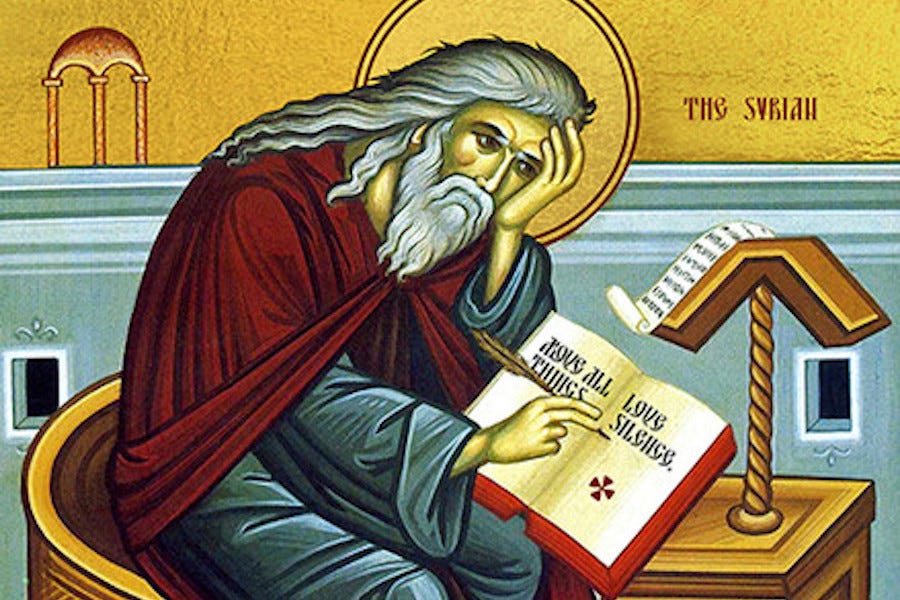
Michael Centore on Nicholas Worssam’s In the Stillness, Waiting: Christian Origins of the Prayer of the Heart: “With its explication of the spiritual voyage as a threefold path of repentance, purity, and perfection—which connects back to the sixth-century Gazan monk Barsanuphius’s threefold path of rejoicing, prayer, and thanksgiving—and its link between purity of heart and luminosity of spirit, the chapter on Isaac stands out for me as the climax or crescendo of the book. I can think of few saints better equipped to heal the pains of our current age than this seventh-century solitary born in Qatar on the Persian Gulf and briefly bishop of Nineveh or present-day Mosul: the passage from his Ascetical Homilies for which he is most known, and which Worssam quotes here as being ‘emblematic of his whole spiritual teaching,’ glows like a burning coal touched to the lips of Laudato Si’ or Teilhard de Chardin’s evolutionary spirituality.”
Read more »
Notes and Events
For readers in the Connecticut area, there will be a brunch to benefit Rosette Neighborhood Village on Saturday, January 24, at 11:30 a.m. The brunch will be held at the Unitarian Society of New Haven (700 Hartford Turnpike, Hamden, Connecticut). Tickets are available at Rosettevillage.org. For $50, you will receive a sumptuous meal and directly support a community by and for people who’ve experienced homelessness.
The contemplative life is essential to grasping the wholeness that may heal divides. But what if contemplation means different things and looks like a different ideal in groups of various races and cultures? Does that mean our spirituality will always separate us? Does that mean we’re reaching for a unity that will always be beyond our reach? Author and spiritual writer Sophfronia Scott will discuss these questions in “The Color of Contemplation” on Tuesday, January 27, at 4:30 p.m. at the Berkeley Center at Yale University (363 St. Ronan St., New Haven, Connecticut). All are welcome—and save the date for Sophronia’s upcoming presentation, “Anam Cara: Thomas Merton, and Pursuing Relationships that Enlighten Our Lives,” at the Holy Family Passionist Retreat Center in West Hartford, Connecticut, on February 21.
Ignatian Encounter Ministry is sponsoring “Breaking Open the Word: Lent 2026.” Each week of Lent, join others from around the world in small Zoom breakout groups for conversation around the weekly gospel. Choose from 27 different 1-hour meetings each week, available in 4 language groups (English, Spanish, French, and Portuguese). Meetings begin on Ash Wednesday, February 18. Information and registration is available here—a great way to build connections across the global church!
Thank you, Michael, for being "jarred". The vibe you created became an entry point. I was especially struck by Kaira's third point: "Seeing that they're caught in systems and structures." We belong to those same systems/structures--another entry point. "To see the person within the oppressor" is part of what drew Jesus to the banks of the Jordan on the Feast the Church celebrated last week, the Bapt of the Lord. Lining up with the sinners going down to plunge into the Waters was how Jesus inaugurated his ministry. His ministry is "the risk of love," as you write, which in fact "makes us more ourselves," that is more the Body of Christ.
Michael - thank you for calling our attention to Love Letter to an ICE Agent. It gave me pause.