


Scroll down for our latest offerings this week, including:
“The Art of Vulnerability,” our latest podcast with Fr. Tom Lynch
“Pope Leo, Mike Johnson, and St. Augustine” by Nancy Enright
Plus upcoming events of interest
Emma Cieslik’s recent piece for her Historical Solidarities newsletter, “Calling Out the Law and Order Catholics,” caught my attention this week.
Cieslik writes of how Bishop Robert Barron condemned an anti-ICE protest at a religious service in Minneapolis last month as an affront to religious liberty, yet “did not make mention of the fact that last April, a judge ruled that ICE can conduct enforcement action in places of worship.” She then provides examples of ICE surveilling and detaining people at Catholic parishes in California and Minnesota.
“These are the assaults on religious liberty that Barron should be criticizing,” she states. “These were acts that violated the dignity and safety of people to practice their faith in the United States, and it connects to a deep history of nativist violence.” “Law and order” Catholics overlook this history, especially the way nativist violence was deployed against their own immigrant communities in the late 19th and early 20th centuries. This makes their position today a failure of both empathy and historical imagination.
Cieslik’s piece has particular valence when set against Sunday’s gospel, where Jesus links his ministry to the Mosaic law: “Do not think that I have come to abolish the law or the prophets. I have come not to abolish but to fulfill” (Matt 5:17). Jesus is the full flowering of the law, its complete and total expression. He does not abrogate what came before but brings it to perfection.
The gospel proceeds with Jesus giving examples of commandments of the law and challenging his audience to go deeper than surface obedience. He wants a total transformation that extends legal personhood to the image and likeness of God. It is not enough to refrain from murder; holding a grudge is enough to devalue a relationship and leave one “liable to judgment” (Matt 5:21-22). Lustful thoughts are already a form of adultery: they are the root of unfaithfulness, and in their objectification of others they trample the grace of human encounter (Matt 5:27-28).
It is the inability or unwillingness to make this leap, to take this risk that really demands something of us, that holds up these “law and order” Catholics in their faith. The message of Christ becomes no more than a social code that takes the radical otherness of the gospel and domesticates it to serve the needs of the state. Tomas Halík’s analysis is apposite here: “The question arises whether the fusion of faith with political power and the incarnation of faith in the form of ‘doctrine’ does not gradually bring about a weakening of that divine power that had so captivated the first disciples of Jesus.” Catholics should fear this weakening above all else, and they should recognize that this “divine power” is not brute strength or will to dominate but rather that “gentle mastery” espoused later in the gospel of Matthew: “Come to me all you who labor and are burdened, and I will give you rest. Take my yoke upon you and learn from me, for I am meek and humble of heart” (11:28-29).
“Be doers of the word, and not merely hearers who deceive themselves,” cautions the Epistle of James. “Those who look into the perfect law, the law of liberty, and persevere, being not hearers who forget but doers who act—they will be blessed in their doing.” True “religious liberty” comes when we tie the law to the person of Christ and strive to meet him in others, even at cost to ourselves. This is the path of freedom through humility traced by St. Symeon the New Theologian: “Christ takes on the appearance of each of the poor and assimilates Himself to all of them so that no one who believes in Him will be arrogant towards his fellow being. On the contrary, he will look on his fellow being and his neighbor as his God.”
Michael Centore
Editor, Tomorrow’s American Catholic
The Art of Vulnerability
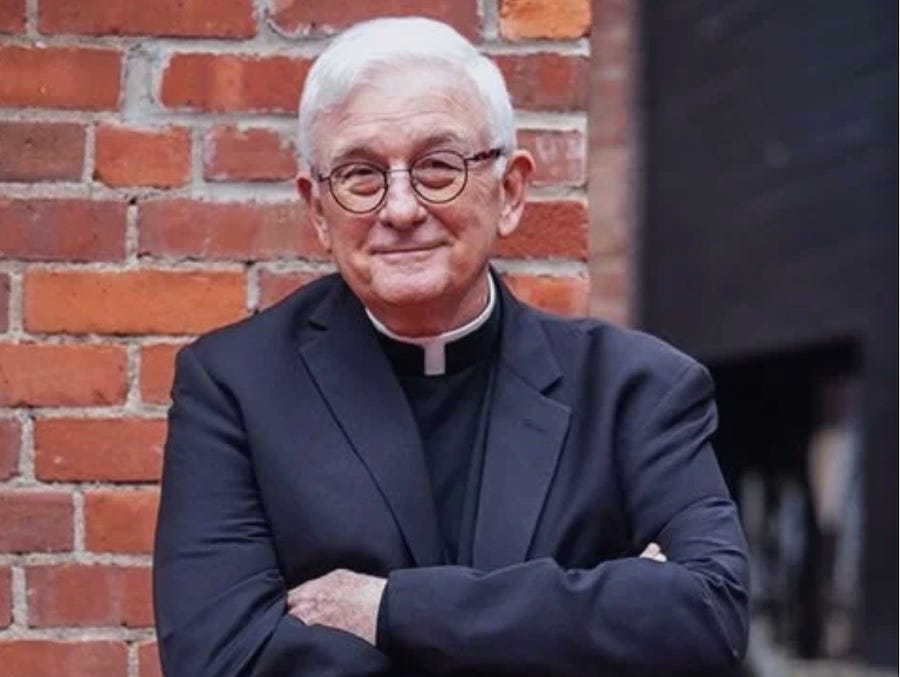
Fr. Tom Lynch served as pastor of Saint James parish in Stratford, Connecticut, for 31 years. Committed to issues of social justice and living the radical demands of the gospel, Saint James earned a reputation for bringing discipleship to life. Under Fr. Tom’s leadership, this vital, engaged community of faith was named one of the top 100 Excellent Catholic Parishes in the United States.
Fr. Tom has served as Family Life Representative for the United States Conference of Catholic Bishops, and served as a Dean within the Diocese of Bridgeport. An experienced family and marriage counselor, he brings together a deep understanding of the spiritual and emotional components that empower the open, honest, and loving conversations loved ones need to have as they walk together.
In this episode, we speak with Fr. Tom about his experiences in the antiwar movement of the 1960s, his vision of the nature of the priesthood, and how he shepherded the parish of Saint James to grow to include some 3,000 families. As he tells us at one point, “It’s really all about relationships, about getting out of our own way, about vulnerability, forgiveness, healing, and letting ourselves be loved by our God.”
Listen here »
Pope Leo, Mike Johnson, and St. Augustine
Nancy Enright on what St. Augustine might say about the differing perspectives of the House Speaker and the pope: “Augustine specifically spoke about the treatment of immigrants in his own day. Many people were fleeing from Rome and its environs to North Africa, where he was bishop, as they were being attacked by tribes coming from the north in Europe. He sermonized at the time: ‘Here it is that by God’s favor we are in winter. Think about the poor, in how to clothe the naked Christ . . . Each one of you wishes to receive Christ seated in Heaven; see him now sheltering in a doorway; see him hungry, thirsty; see him poor, an immigrant [peregrinum]’ (s. 25, 8).”
Read more »
An Open Letter to Stephen Miller
Paul Nyklicek writes from a place of faithful counsel to the White House advisor: “You’re not wrong for valuing strength, but your understanding of it is very narrow. Strength is not merely the crude domination of others by physical force. It is not simply a matter of materialistic advantage. Real strength is much more. It needs no boasting or advertising. It is quiet and humble because it is an expression of wisdom and compassion. Real strength looks to help the disadvantaged. It seeks to give to those in need and to ease the burden of those who suffer.”
Read more »
Notes and Events
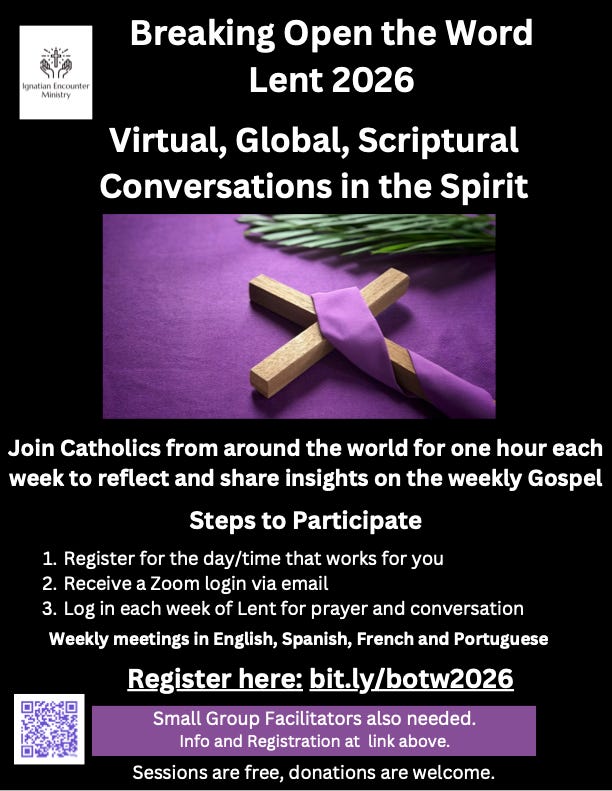
Ignatian Encounter Ministry is sponsoring “Breaking Open the Word: Lent 2026.” Each week of Lent, join others from around the world in small Zoom breakout groups for conversation around the weekly gospel. Choose from 27 different 1-hour meetings each week, available in 4 language groups (English, Spanish, French, and Portuguese). Meetings begin on Ash Wednesday, February 18. Information and registration is available here—a great way to build connections across the global church!
The Blessed Mary Angela Institute for Contemplation, Action and Transformation, an initiative of the Felician Sisters of North America, is pleased to announce its 2026 Lenten Series. These complimentary Zoom presentations will take place over four Fridays in Lent from 1:00 to 2:00 p.m. EST.
Friday, February 20: Felician Spirituality with Sister Jeremy Marie Midura, CSSF, Executive Vice President Charism and Mission Integration, Felician Services Inc.
Friday, February 27: Eucharistic Living with Sister Judith Marie Kubicki, CSSF, Provincial Minister, Felician Sisters of North America
Friday, March 6: Living Contemplatively with Brent Anderson, M.Div., BBC, Charism and Mission Officer, Felician Sisters of North America
Friday, March 20: Contemplative Compassion with Father Thomas Franks, OFM, Cap., Vice President of Mission Integration, Felician University
The link to join these presentations is here. For those in the area, the Lenten Series will conclude with an on-site art tour at the Felician University Rutherford Campus in Rutherford, New Jersey, on Sunday, March 22, 2026, from 1:30 to 4:00 p.m.
The School Sisters of Notre Dame invite participants to read and share their perspectives about “Laudato Si’: On Care for Our Common Home,” hosted by Shalom North America. The sisters write: “Addressed to all peoples, Pope Francis’ landmark encyclical emphasizes that caring for the earth and all humanity is an essential part of our faith, not secondary. Whether you have never read Laudato Si’ or have read it multiple times during its ten-year existence, your perspectives will enhance our understanding of the interconnection of all earth’s communities, our understanding of social sin, and the hope we choose for the future.”
The six sessions are on Mondays at your choice of 2:00 or 7:00 pm ET (1:00 and 6:00 pm CT) on March 2, 16, 30, April 13, 27, and May 11. Participants do not need to attend all sessions. Upon registration, participants will receive questions related to the chapters to guide their preparation.
The first session on March 2 will focus on the introduction and chapter 1, so register here soon! Participants are encouraged to what they can of chapter 1 of the encyclical in advance.
The New York Review has announced a series of seminars on the Bible, hosted by contributor and Pulitzer Prize–winning author, Marilynne Robinson. Her first seminar on the Old Testament begins on March 2. Her second seminar on the New Testament starts on May 6.
“The course as a whole is intended to draw attention to the fact that the Scriptures are, whatever else, a very great literature,” Robinson writes. “Considering their importance to Western Civilization, it is remarkable how vulnerable they are now to misuse and ridicule. Over centuries writers returned to these texts, confident of finding a high order of meaning in them, as great writers have done for centuries after the canon was closed. This is far too extraordinary a phenomenon to be left to cynical use or to neglect.” Registration and pricing information for the seminars is available here.
Well done, as ever.
This is a powerful piece deeply resonating in these times we find ourselves in. More and more culture is co-opting not only our American religious institutions but Catholics in the pew. As Christians we should be striving to embrace the Beatitudes and live Catholic Social Teaching. We can only do that in community and with the help of a mature seasoned faith - not a faith of obligation.