


,_Petersdom_--_2013_--_4330.jpg)
This week, against a backdrop of brazen imperial overreach in Venezuela and another senseless act of state violence in Minneapolis, we watched as the College of Cardinals gathered in consistory in Rome. Moments like these test the newsworthiness of the church, or at least bring it into sharp relief: we are forced to evaluate how such high-ranking Vatican assemblies, so selective in scope and participation, link up with a world that is so openly suffering. As Pope Leo XIV himself said in his impromptu remarks at the end of the first session of the consistory, “We want to be a Church that does not look only at itself, that is missionary, that looks beyond itself, at others. The raison d’être of the Church is not for cardinals, bishops or clergy. Its raison d’être is to proclaim the Gospel.”
That the cardinals selected as their two topics for discussion evangelization and mission in the church in the light of Evangelii Gaudium and the Synod on Synodality is a sign that they intend to continue along path of Pope Francis: Evangelii Gaudium, “The Joy of the Gospel,” was the keystone document of his pontificate, and the Synod his signature initiative. Leo XIV also made expressly clear that he intends for the “full implementation” of the Second Vatican Council, calling it the “guiding star” of the church.
To an outside observer, 60 years may seem like sufficient time to have implemented the teachings of the Council, but generational debates over the nature of the texts versus the “spirit” of Vatican II, the relationship between reform and tradition and a tradition of reform, and the best way of obtaining the formula of the pope’s nominal predecessor, Leo XIII—“to supplement and perfect the old with the new”—created rifts that continue to this day. For his part, Leo XVI seems to adhere to the analysis of German journalist Peter Seewald: “For the Council the opposite of conservative was not progressive but missionary.” The pope, in other words, wants to chart a middle course that consolidates the reforms of Vatican II and uses them as a departure point for the decentralizing spirituality of synodality.
One hopeful result of this consolidation process is that the church can begin to move beyond the inward-looking, self-referential qualities that were necessary to fulfill its aim in Lumen Gentium—“to describe more clearly, and in the tradition laid down by earlier councils, its own nature and universal mission”—but which now must translate from word to deed. Leo XIV showed one face of this movement today, as he followed the consistory with an address to the Vatican’s diplomatic corps in which he lamented that “War is back in vogue and a zeal for war is spreading.” Castigating the use of weapons “as a condition for asserting one’s own dominion,” he said that “This gravely threatens the rule of law, which is the foundation of all peaceful civil coexistence.”
Michael Centore
Editor, Tomorrow’s American Catholic
Past, Present, and Future
After several weeks of planning and pre-production, we are pleased to begin sharing episodes of our new podcast, Tomorrow’s American Catholic. Our podcast is focused on the same question that animates our written work: Who is tomorrow’s American Catholic, and how is their understanding of themselves, their faith, and their church evolving in time?
In each episode, we speak with a spiritual practitioner who helps us envision new forms of Catholic culture and ways of being church. Our guests come from a range of backgrounds and traditions, and we seek to proceed in a spirit of contemplative hospitality and synodal dialogue where we can learn from one another.
In our inaugural episode, podcast co-facilitators Patrick Carolan, Michael Centore, and Barbara Mariconda introduce themselves and their hopes for the podcast, and speak a bit about their vision of “tomorrow’s American Catholic.” Stay tuned this month for episodes with Robert Nicastro of the Center for Christogenesis, author and inter-spiritual pioneer Kurt Johnson, and Therese Lefever of the Burroughs Community Center in Bridgeport, Connecticut.
Listen here »
Liturgy, Synodality, and Sacramentality in the African Church
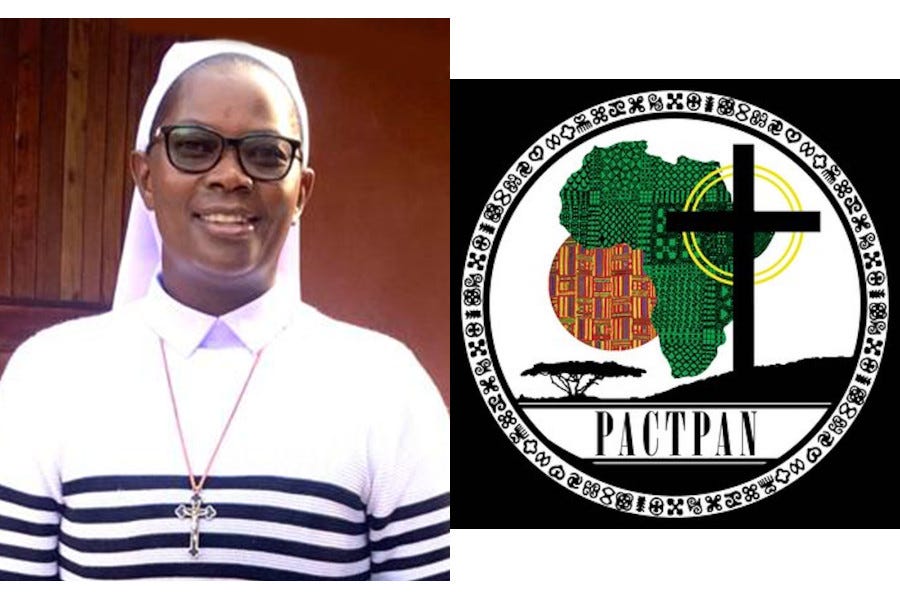
The Pan-African Catholic Theology and Pastoral Network (PACTPAN) was founded six years ago following a gathering in Nigeria to celebrate the Golden Jubilee of the Symposium of Episcopal Conferences of Africa and Madagascar (SECAM) and the 25th anniversary of the first African Synod. The network brings together theologians, philosophers, scientists, social workers, human rights activists, and pastoral agents—both lay and religious—from across Africa and the diaspora.
Recently, members of PACTPAN formed small committees to evaluate the interim reports of the 14 Study Groups of the Synod on Synodality. One of these committees focused on the interim report from the Study Group on the Liturgy. The resulting reflection, “Liturgy, Synodality, and Sacramentality in the African Church,” was drafted collaboratively and synthesized by PACTPAN member Sr. Leonida Katunge.
Sr. Leonida was kind enough to answer a few questions about the aims and intentions of the reflection, as well as offer some background on its composition process. “The African church is not merely a recipient of missionary activity, but an active theological subject capable of offering insights rooted in communal faith, lived experience, and concrete pastoral realities,” she told us. The full text of the reflection is available following our interview.
Read more »
Notes and Events
Beginning on Sunday, January 18, at 12:00 p.m. ET, our friends at Solidarity Hall will be hosting a multi-week reading group centered on Dante’s Inferno. What looks especially timely is that the facilitators will be focusing on the poem’s socioeconomic background—an often under-explored aspect of Dante’s world-building.
Join TAC podcast co-facilitator and former executive director of the Franciscan Action Network, Patrick Carolan, for a presentation on reviving Christianity through the example of St. Francis of Assisi. Titled “It’s Time for a Franciscan Renaissance,” the presentation will be hosted by the Titipounamu Study & Joy Center in New Zealand and will take place on February 16 from 7:00 to 8:00 p.m. (New Zealand Standard Time). Registration information is here, and you can read Patrick’s essay “Towards a Franciscan Renaissance” here.
Thank you for your writing on
In Consistory. What a challenging time we are living in. I’m glad to hear Pope Leo commenting on that.
Also looking forward to your podcast !