

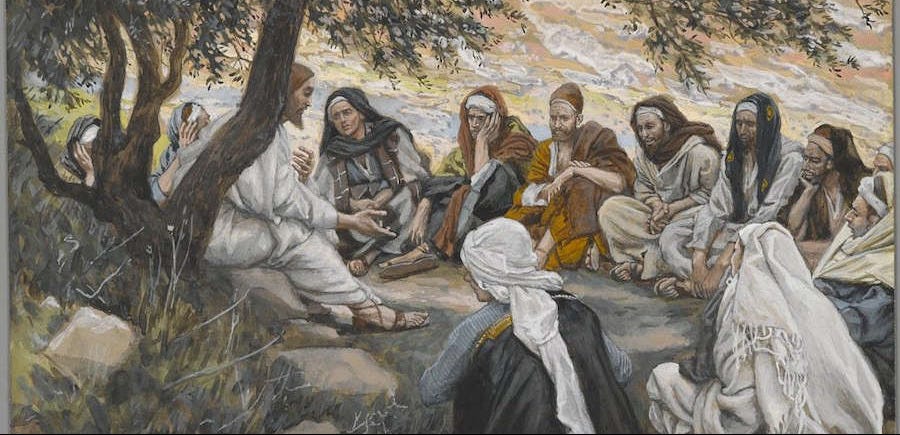
A key word in Matthew’s gospel is mikroi, Greek for “little ones” or, in some passages, “the least of these.” Matthew clearly wants a community of these “least,” these “little ones,” ordinary, humble believers who have no design on positions of power or influence.
– Edward Schillebeeckx
The logic of the Gospel is aimed at small numbers.
– Jean Sulivan
Small communities are the foundations of a new Christianity for this time.
– Rafael Luciani
In addition to publishing work that helps us explore our animating question—Who is tomorrow’s American Catholic, and how is their understanding of themselves, their faith, and their church evolving in time?—our journal hosts and facilitates multiple weekly Zoom-based Small Christian Communities (SCCs) as part of our Mikroi initiative.
Our SCCs use multiple lectionary-based faith-sharing resources, including the contemplative Bible study Ponder from Liturgical Press, weekly reflections from Catholic Women Preach, and the Small Church Community Guidebook authored by SCC proponent Fr. Robert Beloin and adapted by members of his parish community to guide our discussions and prayerful interpretations of the Scriptures. We pay special attention to how each week’s readings touch on the current events in our lives, both personal and those of our church and world.
Participants report feeling empowered by having studied the readings prior to hearing them preached at Mass. Their understanding of the readings is deepened, and they are able to engage more attentively with the homily. Participants also benefit from learning, questioning, and discovering the nuances of the texts together in a space that values parrhesia, or “speaking freely.”
If you are interested in participating in one of our SCC groups or are interested in forming your own, please contact us at editor@tomorrowsamericancatholic.org.
Additional Resources
Organizations
The North American Forum for Small Christian Communities (NAFSCC) is a network of diocesan and parish leaders dedicated to promoting and building on the mutual experience of SCCs rooted in the early church.
The National Alliance of Parishes Restructuring into Communities (NAPRC) offers training, support, resources, and networking to parishes looking to restructure in a clear and deliberate way to stay focused on the Eucharist.
Founded in 1976 as an office of pastoral renewal in the Archdiocese of Newark, New Jersey, RENEW has helped Catholics in more than 160 U.S. dioceses and 24 countries to form small groups for prayer, reading, and reflection. Their materials and training of lay leaders have been made available in more than 40 languages and in Braille.
Small Christian Communities identifies itself as a “global collaborative website” with information and resources on SCCs from around the world. The site also features book reviews, links to online SCCs, and first-person accounts of experiences with SCCs.
The website of the Association of Member Episcopal Conferences in Eastern Africa (AMECEA) features a timeline charting the history of SCCs in the region.
Articles and Essays
“Cords of Human Kindness”: An Introduction to Small Christian Communities
“The Hallowing of the Real”: Small Christian Communities and the Universal Priesthood
Youth Participation in Small Christian Communities in Tanzania: Insights and Recommendations
Small Groups and Social Justice
Discipleship Quads: Cultivating Spiritual Intimacy in a Small Faith Sharing Community Experience
Home Churches Attract Diverse Worshippers
It is conceivable that it will be the task of small communities coming together like swarms one after the other to form what we might call centres of example, that is to say nuclei of life around which the lacerated tissues of true moral existence can be reconstituted.
– Gabriel Marcel
Just because prayer is so personal and arises from the center of our life, it is to be shared with others. Just because prayer is the most precious expression of being human, it needs the constant support and protection of the community to grow and flower. Just because prayer is our highest vocation, needing careful attention and faithful perseverance, we cannot allow it to be a private affair. Just because prayer asks for a patient waiting in expectation, it should never become the most individualistic expression of the most individualistic emotion, but should always remain embedded in the life of the community of which we are part.
– Henri Nouwen