


Jack Hanson is one of our most erudite and insightful commentators on the state of the Catholic Church. His piece for New York magazine on the installation of Ronald Hicks as archbishop of New York in February doubled as a summary review of inflection points in the postwar US church as it moved, in Hanson’s telling, “from the quasi-pagan religion of the ethnic poor into the paragon of prosperous whiteness.” More recently, his appearance on the Know Your Enemy podcast to discuss Magnifica Humanitas helped describe and define that document’s moral infrastructure—its rebuke of authoritarianism, reaffirmation of the importance of discernment and free inquiry, and rejection of the paradigm that prizes efficiency above all else, to name just three key points—that frames its critique of artificial intelligence. (As a sidenote, anyone interested in exploring these themes further should seek out Tom Reese’s multipart series on the encyclical available through Religion News Service.)
Now Hanson has published a must-read essay in the August issue of Harper’s. “Radical Reformation” builds out the historical timeline he essayed in his New York piece to cover the last 150 years of church history, beginning with the annexation of the Papal States in 1870 and tracing the “tenuous and fractious” series of alliances undertaken by the church to maintain its influence within a rapidly shifting political order. “Throughout the first half of the century, it was difficult to gauge whether the Church was cynically tying itself to whatever movement would serve its interests, or attempting to stay as involved as possible in the development of European society in order to steer it away from the worst possible outcomes,” he writes, an articulation of moral ambivalence that brought to mind Tim Parks’s pointed indictment of Pope Pius XI’s decision to sign a concordat with Hitler in 1933: “Church policy, then, was one of compliance born out of intimidation and the conviction that souls could only be saved by the presence of a legally recognized Catholic Church; a return to the embattled and sometimes outlawed condition typical of the early Christian era was not contemplated.”
The essay moves on to the second half of the 20th century, with a special focus on the strengthening bond between the church and the United States—what Hanson calls “a stranger marriage than it may now seem”—throughout the Cold War. The waypoints will be familiar to anyone who’s been shaped by the social dynamics of the church over the past few generations: the flashpoints of the culture wars crystallized in debates over Humane Vitae, the rightward realignment around the issue of abortion “at the expense of nearly every other element of Catholic social teaching,” the tension between “ecclesial alternatives” such as liberation theology that grew out of Vatican II and a reactionary, traditionalist wing attached “to a fervid anticommunism that led to an almost idolatrous relationship to the socio-spiritual order called the West.”
Hanson uses this historical resume to set up the main thrust of his essay: “The Catholic Church’s progressive renewal,” as the subtitle would have it. Picking up with Francis’s pontificate after the “historical nadir” of Benedict XVI’s abdication in 2013, he shows how the re-prioritization of issues such as climate, migration, and protection of the poor and vulnerable transformed the public face of the church and challenged the tacit agreement between ecclesial and state power. Referencing challenges to the pope’s moral authority from professed Catholics J. D. Vance and border czar Tom Homan, Hanson rightly observes, “[F]or members of the administration to turn these rhetorical weapons on the institution that for so long could be counted on to wield them on behalf of the powers of reaction suggests both a rupture within the ideological framework of American empire and an important development in the Church’s self-presentation to the world.”
All of this brings us to the present moment, and to Leo’s deft maneuvering to reclaim not so much an ideological “center” as to orient the church’s political life around the invitations and demands of the Gospel. Hanson quotes his exhortation to attendees at last year’s National Catholic Youth Conference in Indianapolis: “The Church doesn’t belong to any political party. Rather, she helps form your conscience.” For the Jesuit theologian Tomáš Špidlík, conscience was “a stable disposition toward good” that “is always present and always at work in every human activity.” It is that sense of stability in the midst of activity that we are coming to associate with this pontificate, and that gives Leo’s pronouncements on peace and unity their quietly binding force.
A promising through-line of the essay is the idea that the church “is uniquely positioned to set the terms of future progress”—a reflection of the dismantling of the international order before our very eyes, and the (often overlapping) feelings of hope and hopelessness that shape our social, political, and even religious perceptions. Hanson sees Leo as guiding the church away from unstable alliances with foundering nation-states and reestablishing it “as a global community that is not defined by politics or limited by national boundaries.” This feels exactly right, particularly given Leo’s background as a “man of the whole hemisphere” and the spirit of transnational solidarity inherent in the church as a sacrament of unity and the human person as a site of the indwelling Trinity.
The other part of this is a reckoning with and reassessment of the church’s relationship to power: who wields it and how it should be used to more closely align with the Beatitudinal vision of Christ. Francis instigated this with his frequent professions of “servant leadership” and his ongoing synodal project to democratize decision-making in the image of the “inverted pyramid”; now, it seems, Leo has an opportunity to not only guide that project through its implementation (Matthew Shadle published a fine piece on the latest developments on that front earlier this week) but to export its animating features of communion, participation, and mission to the church’s dealings with the world at large. When Hanson writes that “It may seem paradoxical, but increasingly, the Church, which for so long struggled to navigate powerful states, may now best be defined by its opposition to power itself,” or characterizes the conclave’s decision to elevate the humble “Father Roberto” Prevost to the Petrine ministry as being “made to continue the work of reclaiming the Church for the vulnerable and against state and technological power,” he is both setting this sea change in its historical context and pointing to the refreshed ecclesial self-conception set forth in paragraph 20 of Magnifica Humanitas:
[T]he Church offers herself in a way that helps to interpret reality in all its depth. She supports with humble firmness the choices that promote the dignity of every person, the cohesion of communities and the good of all. The Church thus stands alongside the world without overpowering it, so that the promise of justice and peace that the Holy Spirit continues to sustain in the heart of humanity may come to fruition in every human endeavor. ♦
Michael Centore
Editor, Tomorrow’s American Catholic
Centering the Teachings of Christ
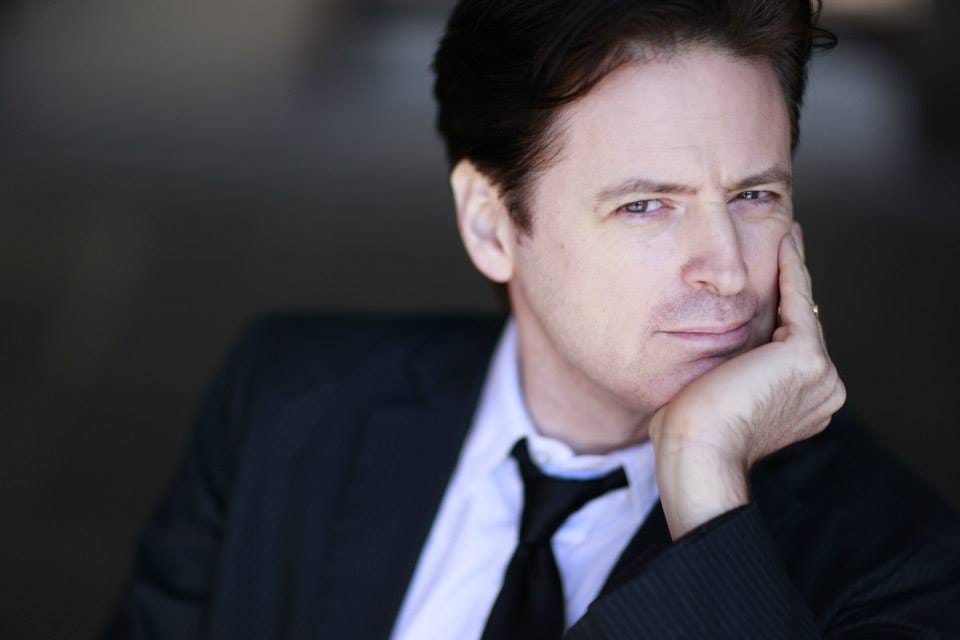
John Fugelsang is an actor, author, political commentator, comedian, and broadcaster who currently hosts the progressive talk show Tell Me Everything on SiriusXM. His many and varied acting credits range across film, television, and stage productions. He has hosted and co-hosted multiple shows, including CNBC’s Bullseye and the political talk show Viewpoint. He is a regular guest on CNN, MSNBC, and other networks, and has contributed to the Huffington Post and the Daily Kos.
In this episode, John shares with us the story of his parents—a nun and Franciscan brother who fell in love and left their respective orders—and how they influenced his spiritual development and early relationship to the Catholic Church. He explores the image of Jesus as a “chain-breaker,” examines the gospel narrative as “an incredible example of resisting empire and authoritarianism in really interesting, creative, loving ways,” and engages with Christianity as a religion “not about domination, but transformation.”
Listen here »
A New Peace Corps
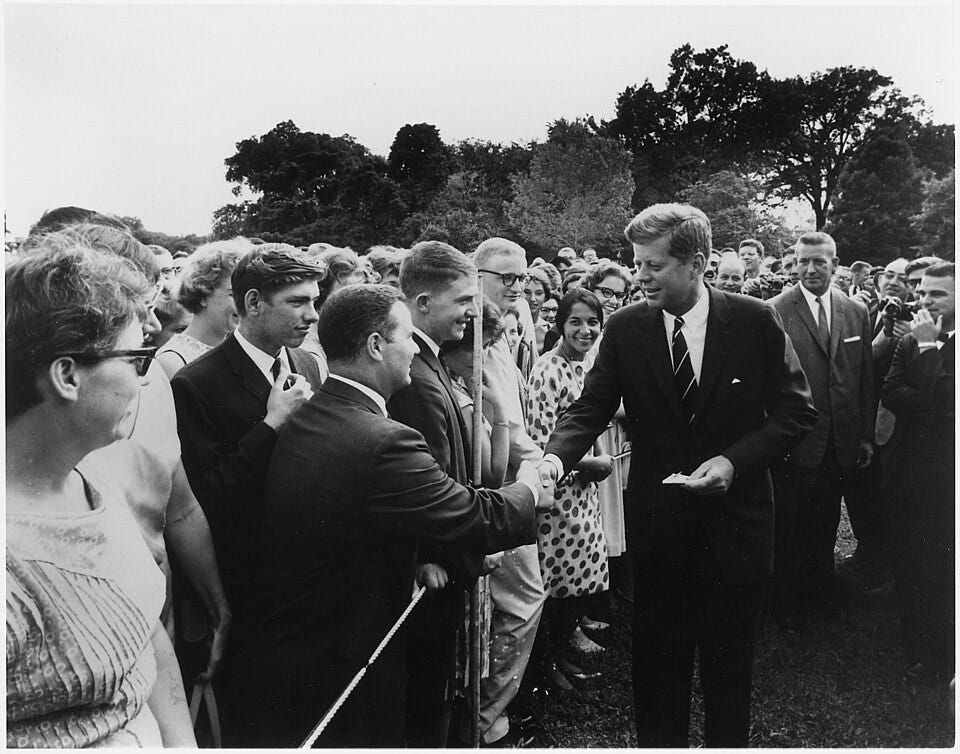
Patrick Henry offers five points for a revitalized Peace Corps: “At the height of the Cold War, John F. Kennedy was insisting that he represented a new generation of Americans that would work for global solidarity against tyranny, poverty, disease, and war itself. Less than two months later, on March 1, 1961, he signed Executive Order 10924, thereby creating the Peace Corps, whose goals were to help underdeveloped countries, to promote global understanding, and to build world peace. Today, 65 years later, it’s time for a new generation of Americans to create a new Peace Corps for the 21st century.”
Read more »
The Day I Gave My Confirmation Talk—2004
A poem by Sr. Lou Ella Hickman, OVISS:
They have grown into their future since then.
Becoming my past    a dot of memory
that returns with what I wish I could have told them
          with what I know now. . . .