


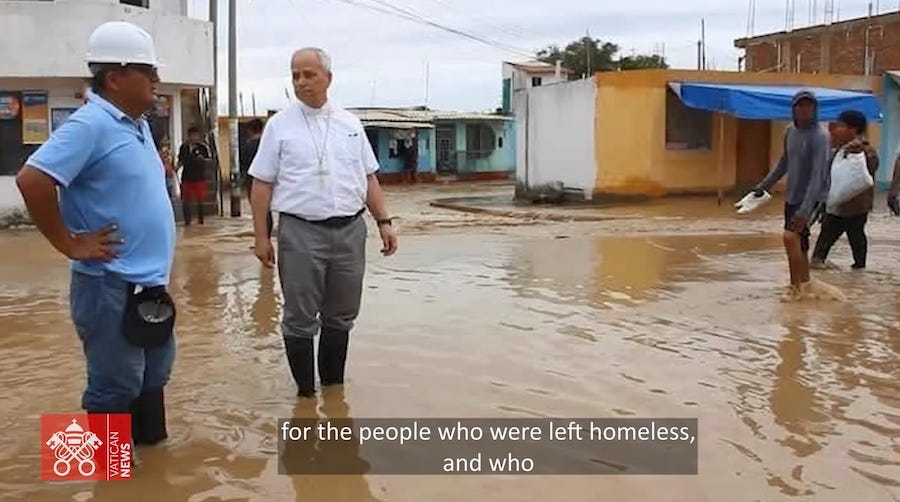
There is a moment in Leo from Chicago, the short documentary produced by the Vatican’s Dicastery for Communication that we looked at last week, where one of Robert Prevost’s Augustinian brethren marvels at how the young priest, freshly minted with a Doctor of Canon Law degree from the Angelicum in Rome, could have had his pick of any number of academic or ecclesial appointments. Instead, the brother muses, he chose that moment to embark on what would be a multiyear missionary journey to Peru—working largely on the outskirts of the cities, living the vision of the church as “field hospital” long before Pope Francis gave us the image.
That period of Prevost’s life is covered in León de Peru, the third of the three-part series rounded out by Leo from Chicago and Leo in Rome. The prevailing tone of the documentary is similar to the previous two: interviews with Leo’s former parishioners, fellow Augustinians, and diocesan staff tell the story of a “humble, fraternal, open” man, an “ordinary, everyday man,” who entrusted his flock with the faith and encouraged them to develop it in prayer, reflection, and action. One Augustinian sums up this mixture of spiritual simplicity and social awareness with a telling premonition: “I believe Pope Leo XIV will always be Father Roberto, the man with the warm smile, but also a man of high standards.”
The name “Father Roberto”—or its close cousin, “our brother Roberto”—is a preferred title throughout the documentary, and it seems that Prevost never strayed far from the pastoral roots of his vocation. Even after he was elevated to Bishop of the Diocese of Chiclayo in 2015, he maintained his identity as a man of and with his people. “We were all his children, his siblings, his family,” recalls one interviewee; another, recounting the bishop’s response to the devastating floods in the north part of the country in 2017 in which he arranged to provide housing, food, and other necessities for those who had been displaced and participated in direct-aid efforts himself, says that “he was loved because he got involved with the people.”
Watching this documentary having followed the various stages of the still-unfolding Synod on Synodality, with its documents of dense thickets of Vatican-ese and, at times, self-referential theologizing, was a reminder that the church’s mission is always outward, away from itself as a set pattern or static institution. There is a story of Bishop Prevost sending doctors to visit the sick and infirm in his diocese that illustrates this well: a church that is nimble and decentralized enough to respond to individual needs as they arise—to improvise, as it were, not as an NGO might but as a collective bound together by an ethic of service. That nimbleness, that freedom to respond is the special gift of the church to the world because it demonstrates, at its best, how we might voluntarily associate around our own free response to the higher law of God’s love. Reading paragraph 16 of his inaugural encyclical, Magnifica Humanitas, it’s clear that “Father Roberto” has retained this perspective even after assuming his new office as Bishop of Rome:
I address this heartfelt appeal to all the Catholic faithful, to all Christians and to all men and women of goodwill. Let us not be afraid to get our hands dirty on the “construction site” of our time. Like Nehemiah, let us pray, plan wisely and work perseveringly, placing God at the forefront of our actions and the human person at the center of our choices. Thus, the “rejected stones”—the poor, the sick, the migrants and the least among us—will become the cornerstone, and a solid, welcoming common home will emerge on the earth, where love and faithfulness will finally meet, and righteousness and peace will embrace (cf. Ps 85:10).
Michael Centore
Editor, Tomorrow’s American Catholic
Flipping the Tables
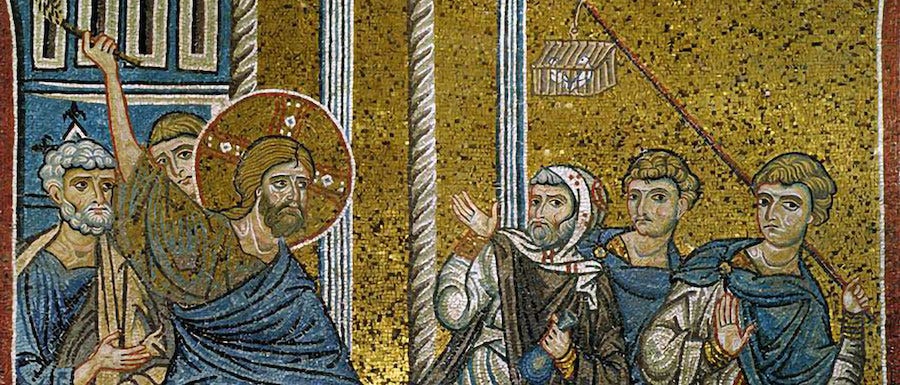
We are excited to partner with Flipping the Tables, a new podcast about Catholics working for peace and justice hosted by journalist, activist, and past TAC contributor Colleen Shaddox. Colleen’s work has appeared in The New York Times, The Washington Post, America, and many other publications. She’s been recognized by the Catholic Press Association for feature writing and by the Connecticut Society of Professional Journalists for excellence in podcasting. She is also the co-author, with Joanne Samuel Goldblum, of Broke in America: Seeing, Understanding and Ending U.S. Poverty.
Flipping the Tables has already released episodes with organizers from the Ark of Noah Fund that assists families who have been targeted by ICE; Natalie Wasek, Director of Corporate and Social Responsibility for the Sisters of St. Francis of Philadelphia; Lincoln Rice, coordinator of the National War Tax Resistance Coordinating Committee; and Catholic Worker Mark Colville, with more scheduled for release soon. We will feature new episodes in our weekly newsletter and are exploring ways to include episodes directly on our website. To listen, visit the Flipping the Tables website here.
Church, Priesthood, and Global Engagement
The Association of U.S. Catholic Priests (AUSCP) recently completed its 15th Annual Assembly, held in St. Louis from June 22–25.
Centered on the theme “Building the Future: Church, Priesthood, and Global Engagement,” the assembly brought together ordained priests and lay friends to “deliberate on structural renewal, global migration, and the evolving role of pastoral leadership within a modern, relational Church,” according a statement released by the group.
The gathering opened with an Ignatian-themed retreat facilitated by Dr. Damian Zynda. Keynotes came from Fr. Dan Groody, CSC, on migration theology, and Sr. Kathy Duffy, SSJ, on the thought of Teilhard de Chardin.
Cardinal Mario Grech sent a Vatican address that drew on Pope Leo XIV’s encyclical, Magnifica Humanitas. Grech’s address “fram[ed] the modern priest as a ‘co-builder’ of communion rather than an architect of isolation” and “stressed that synodality does not threaten ordained ministry, but instead offers the framework to alleviate clergy loneliness and structural polarization,” the statement reports.
In his annual State of the Association Address, AUSCP Executive Director Fr. Steve Newton, CSC, proposed a “paradigm shift” in how the association understands its own membership.
“Instead of seeing ourselves as a membership-driven organization, let’s become what our name says we are—a true Association of U.S. Catholic Priests!” Fr. Newton said. “Let’s operate on the assumption that, by virtue of ordination rather than paid membership, all priests ministering in the United States are in association.”
During the assembly, members discussed and adopted a 3-to-5-year strategic plan “aimed at building a Church where ordained and lay people co-labor synodally,” the group said in a separate statement. Key priorities of the plan include continuing the organization’s long-term focus on anti-racism, care for creation, gospel nonviolence, and women’s inclusion in the church, as well as updated programming to engage younger priests.
Archbishop Mitchell Rozanski presided at the assembly’s closing liturgy, which honored Fr. Gerry Kleba, Fr. John Heagle, and Bishop John Stowe, OFM Conv.
The Association of U.S. Catholic Priests is the largest association of Roman Catholic priests in the United States. Founded to keep alive the pastoral vision of the Second Vatican Council, the AUSCP serves as a prophetic voice and a sanctuary of professional and spiritual support for clergy and lay friends working to build a synodal, missionary church.
The AUSCP announced its 2027 assembly will be held in Orlando, Florida, and will focus on the extensive pastoral and societal implications of Magnifica Humanitas.
Poetry, Loss, and the Longing for God
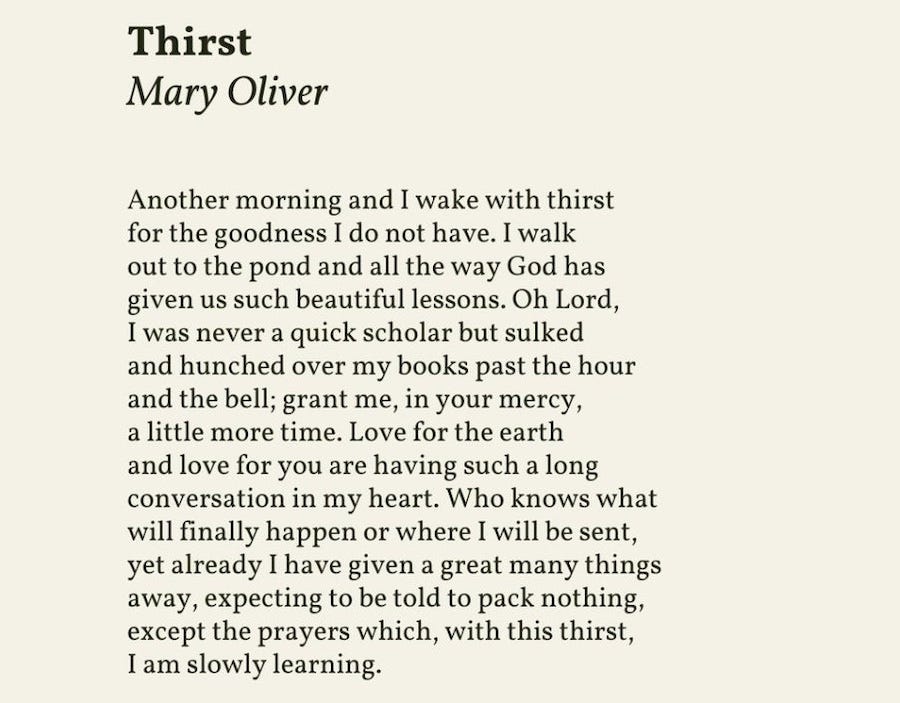
Join Br. Mark D’Alessio for the annual Mary Oliver retreat at Wisdom House (229 E Litchfield Rd, Litchfield, CT 06759) on August 22 from 9:30 a.m. to 3:30 p.m. ET. Mary Oliver is a favorite of poetry lovers of all ages for her lyrical, intimate, and sensitive poems, many of which use nature as a lens for exploring a wide spiritual spectrum of human emotions, from love and joy to sorrow and despair.
The retreat will center on Oliver’s 2006 collection Thirst, which she wrote after the death of her partner. Through reflection, contemplative practice, and guided conversation, retreatants will invite Oliver’s poems to become companions on their own journeys of loss, healing, and hope.
“Summer gently reminds us to slow our pace, breathe more deeply, and notice the quiet beauty that is always waiting to be discovered,” writes Br. Mark. “I hope you’ll join me next month in August for a contemplative retreat: my annual Mary Oliver Poetry Retreat, where we’ll listen for the sacred through poetry and the natural world. You are welcome to join us for an opportunity to rest, renew, and awaken more fully to the Presence already within and around you.”
Br. Mark adds that no prior knowledge of Oliver’s work is needed—only an openness to allow poetry to speak to the heart: “Come walk with us through Thirst and discover how grief, too, can open us more deeply to love, resilience, and the quiet hunger for God.”
Cost is $85, with lunch included. To register, click here. For information about overnight accommodations, call Wisdom House at (860) 567-3163.
Wisdom House is an interfaith retreat and conference center founded by the Daughters of Wisdom. The Center presents programs in spirituality, wellness, the arts, and ecology, and welcomes people of all backgrounds and beliefs.
The Rt. Rev. Br. Mark D’Alessio is a Franciscan friar, bishop and priest, ordained lay Buddhist, spiritual director, chaplain, author and retreat leader, and former president and executive director of the Psychotherapy & Spirituality Institute. Our podcast episode with Br. Mark, “Hatching Open the Heart,” is available here.