


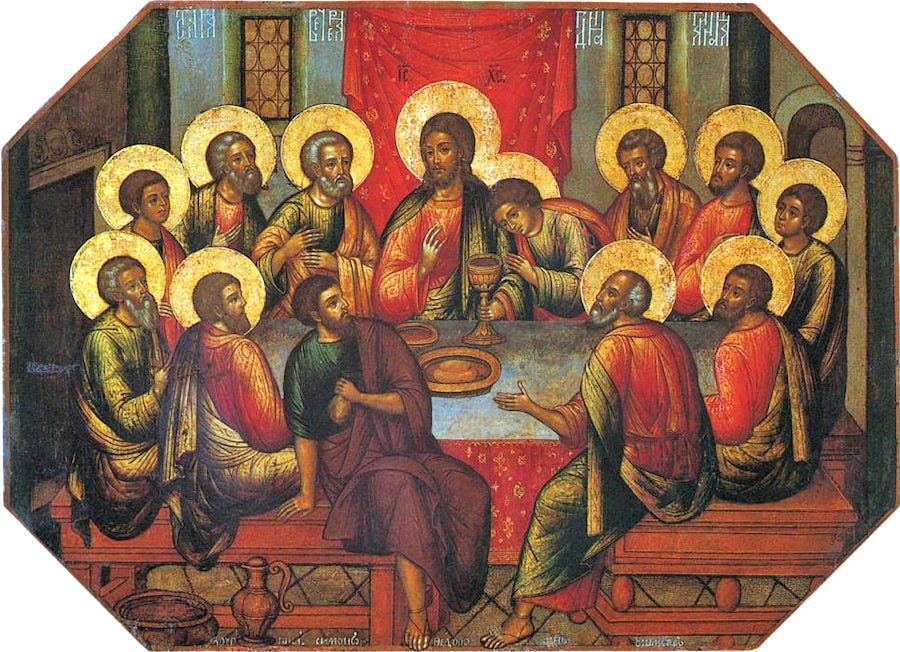
Part I of “The Last Supper: Last(ing) Lessons” was published on March 30, opening our series of offerings for Holy Week. Now, book-ending the Easter season and in preparation for Pentecost, we’re pleased to share the second part of O’Neill D’Cruz’s essay interpreting Jesus’s instructions at the Last Supper to “do this in memory of me.”
In Fr. Erik Varden’s homily for the Solemnity of the Ascension, he describes the day as “mark[ing] the end of the first forty days of Paschaltide, corresponding to the forty days of Lent.” He adds a beautiful image with appropriate baptismal overtones: “The two periods are like giant waves flowing up to, then away from, Easter: ebb and flow.”
Like a mirror to Holy Week, this period between the Ascension and the arrival of Pentecost is a time, Varden writes, of “recollection, silence, and expectancy.” As we waited for the promise of the resurrection then, so we wait now for the sending of the Spirit and its impression upon what O’Neill names here as the “heart-prints of Christian compassion”—Ed.
We must obey God rather than men.
– Acts 5:29
When the apostles sought high places in his kingdom, Jesus warned them: “You know that the rulers of the Gentiles lord it over them, and their high officials exercise authority over them. Not so with you. Instead, whoever wants to become great among you must be your servant” (Mark 10:42-43). Jesus also outlined how high officials of religious organizations exercise authority over faith communities: “Beware of the teachers of the law, who like to go around in long robes and accept greetings in the marketplaces, seats of honor in synagogues, and places of honor at banquets. They devour the houses of widows and, as a pretext, recite lengthy prayers” (Mark 12:38-40). Two thousand years later, one can identify the “Roman kingdom” and the “catholic kin-dom” models in today’s Roman Catholic Church. The former is predicated on the love and service of temporal power, the latter on the power of eternal love and service.
How well did Jesus’s earliest disciples comprehend his last(ing) lessons to define their mission? Judging by the first few chapters of Acts, as poorly and/or as well as we do two thousand years later. We find early signs that the community of believers would follow parallel paths, and we trace both paths to present-day interpretations of Jesus’s instructions at the Last Supper to “do this in memory of me.”
In Acts 1, the disciples’ foremost concern is unchanged from before the Last Supper, and it pertains not to any of the lessons of Last Supper, but rather to empire building. When Jesus was among them, the disciples vied with each other for place and rank in the kingdom to come and asked about future returns on their investments. After Jesus’s resurrection, their first question referred to a timeline: “Are you at this time going to restore the kingdom to Israel?” (Acts 1:6). While waiting for the Holy Spirit, Peter, the apostle who denied Jesus three times, found it “necessary to choose one of the men” (Acts 1:21) to replace Judas, the apostle who betrayed Jesus. Instead of the all-inclusive participation at the Last Supper, the church that Peter organized denied one half of the faith community—women—from being nominated for the first recorded election for the apostolic ministry.
When communal sharing was centralized “at the feet of the apostles, to be distributed to any who were in need” (Acts 4:35), Greek-speaking believers voiced grievances (Acts 6:1) since, unlike at the Last Supper, they were denied equal access to the daily distribution (Acts 6:1). This led to distribution of tasks by rank, which was the opposite of what Jesus had demonstrated to his disciples at the Last Supper (John 13:13-15). The apostles chose to preach and pray rather than “wait on tables” (Acts 6:2) as Jesus did, and again denied women equal participation in apostolic ministry (Acts 6:3).
While the apostles were supported in their ministry by the prayers and possessions of believers who lived the lessons of the Last Supper, the community also demonstrated fear-based compliance with apostolic mandates (Acts 5:11) and hero worship (Acts 10:25). Thus, with or without their knowledge, the all-too-human apostles who worked earnestly to “obey God rather than men” (Acts 5:29) put in place a “management model”—selective nomination for leadership positions, bias and discrimination, unequal access due to exclusion and favoritism, fear-based compliance, hero-worship of leaders—that replicated the strategies and tactics of Rome and other power-based, worldly empires.
In our times, this “kingdom”-management model persists in the form of a clerically oriented church. The “kingdom” model adopted the Latin word for church, ecclesia, which is derived from the ancient Greek ekklesia, the governing body composed of wealthy male citizens. In the “kingdom” model, Christ is “king,” every pope shares the title pontifex maximus with Caesar and the Roman emperors, cardinals are the “princes of the Church,” and male clergy hold rank-based honorific titles. At a diocesan level, the managerial role of the clergy is highlighted by the familiar English word bishop, derived from Spanish obispo and Latin episcopus, meaning supervisor, overseer, or foreman. Patriarchy, hierarchy, clericalism, and authoritarianism, which are not aligned with the lessons of the Last Supper, are hallmarks of the clerically oriented church. It is supported and sustained by a faith community that endorses “pay-pray-obey” as the preferred form of spiritual practice.
Theologically justified wars of the cross (e.g., the Crusades), invasions and inquisitions, and acquisition of property and territory (e.g, the Doctrine of Discovery) are among the footprints of Christian imperialism across the sands of time. Thus, the urge to build a Christian “kingdom” on earth in the name of Jesus, who explicitly stated “my kingdom is not of this world” (John 18:36), began in the very first chapter of Acts and continues to this day. It is surely not what Jesus meant when he asked his disciples to “do this in memory of me.”
Meanwhile, in Acts 2, the Holy Spirit is poured out without prejudice and removes all regional and language barriers. While the early church excluded entire groups (women and Gentiles, for example), the Holy Spirit was clearly not limited to or by these practices. Both Saul, whose militant tactics to preserve the integrity of the Jewish faith tradition (Acts 8:3), and Peter, whose purity codes dictated no interactions with Gentiles (Acts 10:28), needed heavenly visions (Acts 9 and 10, respectively) to realize that, similar to the uninitiated people that Jesus taught in parables, they had seen but not perceived, heard but not comprehended the catholicity of his new commandment. Both came to realize that “God shows no partiality; rather in every nation all those who revere God and do what is right are acceptable to him” (Acts 10:34-35). To remove any lingering doubt after Peter’s heavenly vision, the Holy Spirit descended on the Gentiles before they were baptized by the apostles and well before the faith community “were first called Christians” (Acts 11:26)! Devout folks from all stations and walks of life—the Samaritan community, an Ethiopian eunuch, and a Roman centurion—were added to the community of believers.
The diverse and beloved community of believers followed the lessons of the Last Supper by being radically inclusive. The community-based church actualized these lessons early and often. Bread broken in domestic settings was followed by joyful and generous universal sharing, worship and fellowship were communal, and co-operative ownership was the hallmark of stewardship of earthly goods (Acts 2:42-46). In the faith communities of the first century, we read about examples of fidelity and faith (“the entire community was united in heart and soul” [Acts 4:32]) as well as persecution and martyrdom (as in the story of Stephen in Acts 7). Along with fraud and fear (as in the story of Ananias and Sapphira in Acts 5:1-11), bribery, simony, false witness, and other assorted practices found their way into the community of believers.
In our times, the community-oriented “kin-dom” model is present “where two or more are gathered in [Jesus’s] name” (Matt 18:20). In the “kin-dom” model, Christ is “friend”(John 15:15) and “brother” (John 20:17), and the community functions as “members one of another” (Eph 4:25). This model is supported and sustained by a faith community that ministers to human needs as spiritual practice, based on Jesus’s example and advice: “If I have washed your feet, you also should wash one another’s feet” (John 13:14).
In Tracy Kidder’s Rough Sleepers, we read how volunteers, including physicians, wash the feet of the homeless population they serve. The Whole Language: The Power of Extravagant Tenderness outlines attitudes and models for radically inclusive approaches based on author Greg Boyle’s lifelong work with gang members. In contrast to nulla salus extra ecclesiam (“No salvation outside the church”), the Latin American liberation theologian Jon Sobrino proposes a community-oriented approach in No Salvation Outside the Poor. Truth and Reconciliation Commissions, such as those organized by Desmond Tutu in post-apartheid South Africa, are models for forgiveness and healing from historical and intergenerational trauma. Do these examples sound closer to Jesus’s Last Supper deeds when he said, “Do this in memory of me”?
Charitable institutions that care for the sick, poor, and orphans, humanitarian aid and relief efforts, and social service organizations that work to restore human dignity are among the heart-prints of Christian compassion and “kin-dom” across the ages. Thus, the outpouring of healing and grace that began with the descent of the Holy Spirit as described in the second chapter of Acts continues to shower us with blessings to this day.
Finally, let us note that being a cleric or community member does not automatically define one’s affiliation with one of these models of church, but rather by how well one actualizes Jesus’s new commandment and the ideals and lessons of the Last Supper in one’s daily life. As G. K. Chesterton famously wrote, “The Christian ideal has not been tried and found wanting. Rather it has been found difficult and left untried.” Thus, how well we “do this in memory of me” begins with and depends on whether or not we do this: the “to-do” list of the Last Supper parable mission statement.
At Pentecost, we celebrate the birthday of the already-and-not-yet, “one, holy, catholic and apostolic church.” May the Holy Spirit empower all of us on the faith journey to “obey God rather than men” as we emulate Jesus’s last(ing) lessons and follow Mary’s advice: “Do what he tells you” (John 2:5).
Envia tu Espiritu,
Sea renovada la faz de la tierra
Send us Your Spirit
May the face of the earth be renewed
Spirit of the living God, burn in our hearts,
And make us a people of hope and compassion.
Amen! ♦
O'Neill D'Cruz retired once from academic clinical practice as a pediatrician and neurologist, a second time from the neuro-therapeutics industry, and now spends his time caring, coaching, and consulting from his home in North Carolina, known locally as the "Southern Part of Heaven." He is a wounded healer who works to heal the wounded, in order that All Shall Be Well.
This was an insightful and important piece. I’ve always experienced a vague discomfort in hearing readings from Acts after Easter - a sense that ‘it’s already starting’ - the clericalism and institutional nature of the church. Thank you for validating my feelings and putting words to my discontent - and naming an alternate model of church as we strive to “do this in memory of me.”
Great article Michael ! Congratulations on your four month anniversary ! I know that excitement. We just launched our new website at Veteran artinstitute.org. And we are very excited. Over 6000 works of art.
Kindly, KATHLEEN