


Part I of this essay is available here.
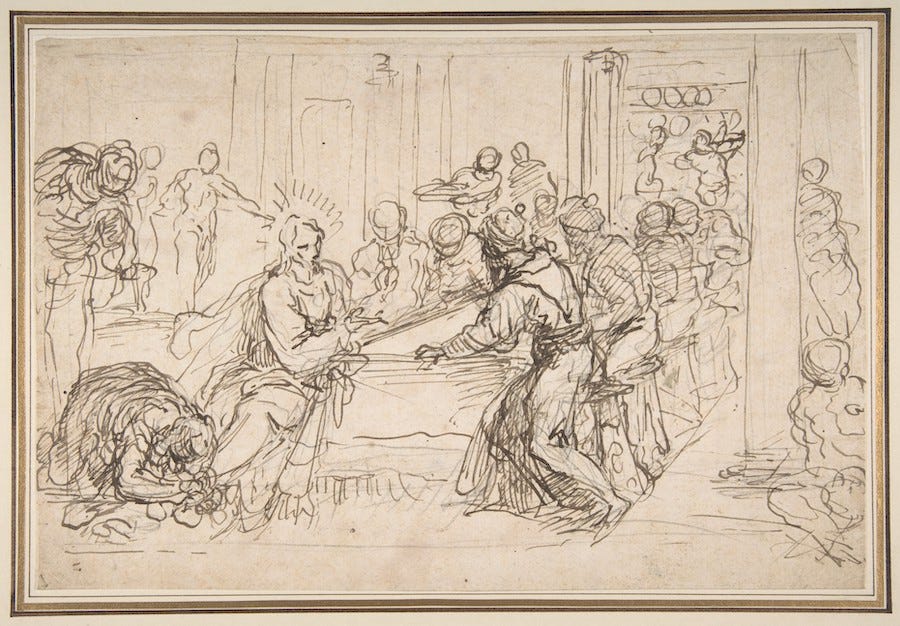
Despite the canonical gospels’ portrayal of Mary Magdalene as the first witness of the resurrected Christ, early church fathers earnestly attempted to discredit these accounts. Mary’s role was certainly a source of discomfort for these men trying to establish the true church of Christianity. In her essay “Excellent Women: Female Witness to the Resurrection,” Claudia Setzer mentions some of those who interfered with the affirmation of the indispensability of Mary’s role in the gospels: Justin Martyr, in the mid-second century, presents a number of proofs for the reality of the resurrection in his Dialogue with Trypho, yet conveniently leaves out the report of Mary Magdalene and other women; Celsus attempts to discredit the resurrection as a fraud by saying that it was only reported by an unreliable “hysterical woman”; John Chrysostom focuses on the vulnerability of women to the snares of the synagogue; and Jerome cites examples of women leading men into heresy.
These Orthodox Christians also had to battle with the exaltation of Mary Magdalene by “heretics.” According to Susan Haskins in her book Mary Magdalen: Myth and Metaphor, the Gnostics and Manichees held an image of Mary as “an apostle and spokeswoman for their arcane doctrines, a female figure more important in many of their writings than the male apostles.” These groups, as well as the Montanists of Asia Minor in the second and third centuries, allowed women to teach as apostles. There was a grave necessity for all the early church fathers to call them heretics in order for normative Christianity to uphold an elite male apostolic succession. When it came time to assemble the canon, every secret Gnostic text was omitted. Various scholars have put all the facts of the controversy together with their reclaiming of Mary Magdalene as equal to the male apostles, based on the consistency of her appearance in the Synoptic and the Gnostic Gospels.
The Historical Reality
Feminist scholarship written about the canonical Mary Magdalene has relentlessly equated her with the male “Twelve.” It is within these persistent and determined texts and interpretations that women can regain their apostolic succession, yet because the Synoptics and Johannine texts are so completely androcentric, it is difficult to recapture her true identity. The source of Magdalene’s canonical apostolic exclusion derives directly from the passage of the calling of the “Twelve” in Mark 3:13-19:
He went up the mountain and called to him those whom he wanted, and they came to him. And he appointed twelve to be with him and to be sent out to preach and to have authority to cast out demons. So he appointed the twelve: Simon (to whom he gave the name Peter), James son of Zebedee and John the brother of James (to whom he gave the name Boanerges, that is, Sons of Thunder), and Andrew, and Phillip, and Bartholomew, and Matthew, and Thomas, and James son of Alphaeus, and Thaddaeus, and Simon the Cananean, and Judas Iscariot, who handed him over.
At this point, Mark’s narrative world limits leadership to only men. In her commentary on Mark from Searching the Scriptures, Joanna Dewey presents a feminist analysis of this passage:
Is Mark’s narrative world an accurate reflection of the historical reality of Jesus’ ministry? Would Mark’s audience, especially the women in Mark’s audience, understand the narrative world as restricting their own leadership in Christian communities? First, the restriction of the inner circle around Jesus to a few men is probably not historically accurate. It is doubtful that Jesus himself names twelve men or any specific group to extend or continue his ministry. More likely, this portrayal is due to men’s efforts after Easter to establish their own authority. The primary method of transmitting Christianity was oral, and there were Christian women storytellers and teachers. Most of the women and many of the men would have heard Christian women tell stories of women healing and preaching. Thus they probably heard Mark’s story neither as an accurate picture of the women associated with Jesus nor as an authoritative guide for their present Christian roles, but rather as one story among several. For first-century Christians, Mark’s androcentric perspective would have been balanced by other, more gynocentric, perspectives. Women’s oral traditions have not survived, however, except as they have been filtered through men’s perspectives and codified in men’s writings. As a result we have come to mistake Mark’s androcentric narrative world for historical reality.
A passage such as Mark 3:13-19 always brings out the most strident reactions in feminist scholars of the gospels. The root of the problem lies in the ramifications of such passages, when they manifest themselves as overt signs of oppression, such as male apostolic succession. “Mark’s presentation of the disciples’ blatant failure to understand Jesus’ message (6:51-52; 7:17-18; 8:14-21, 32-33; 9:31-32; 10:13-14) coupled with their dismal performance during Jesus’ time of need in Gethsemane (14:32-50) makes Mark’s twelve into a considerably less admirable group than is the case in the other three New Testament Gospels, all of which strive with mixed success to rehabilitate the disciples’ image, at least after the resurrection,” writes Mary Ann Tolbert in The Woman’s Bible Commentary. Elisabeth Struthers Malbon adds in her essay “Fallible Followers: Women and Men in the Gospel of Mark”: “It would seem that the historical reality of women’s lower status and the historical reality of women’s discipleship together support in Mark’s Gospel the surprising narrative reality of women characters who exemplify the demands of followership.”
Accolades of Praise
Like Magdalene, the other woman who is mentioned in all four gospels is the anointing woman:
While he was at Bethany in the house of Simon the leper, as he sat at the table, a woman came with an alabaster jar of very costly ointment of nard, and she broke open the jar and poured the ointment on his head. But some were there who said to one another in anger, “Why was the ointment wasted in this way? For this ointment could have been sold for more than three hundred denarii and the money given to the poor.” And they scolded her. But Jesus said, “Let her alone; why do you trouble her? She has performed a good service for me. For you always have the poor with you, and you can show kindness to them whenever you wish, but you will not always have me. She has done what she could; she has anointed my body beforehand for its burial. Truly I tell you, wherever the good news is proclaimed in the whole world, what she has done will be told in remembrance of her.” (Mark 14:3-9)
Each gospel writer includes this pericope with differing details (Matt. 26:6-13, Luke 7:36-50; John 12:1-8), yet not one of them omits the dialogue between Jesus and the argumentative speakers. This is the only woman in all four gospels who receives an overt defense from Jesus, and who, moreover, is praised for her good deeds while receiving special preference over and above the disciples. It stands to reason that if all the canonical gospel authors chose to include this passage as well as retain the words of praise of Jesus on her behalf, she must have been an essential female character.
There are all sorts of interpretations as to who this anointing woman really was. Some scholars doubt the historicity of the event, while others claim that the woman was one of the female prophets of the ancient world. (It is worth noting, however, that she is not recognized as a prophet in any of the four gospel accounts.) Nonetheless, as Karen Jo Torjesen writes in When Women Were Priests: Women’s Leadership in the Early Church & the Scandal of Their Subordination in the Rise of Christianity, the woman “had received insight into who Jesus was, and she felt compelled to give a public witness to his identity. She did not choose words for her prophetic revelation; she chose a silent portentous action.”
Prior to this passage, the author of Mark has introduced several women into Jesus’s story, so that by the time the audience hears about the anointing woman, they begin to feel comfortable with the special attention he gives to his female interlocutors. Unlike other Markan characters whom Jesus calls, heals, and teaches, this woman’s action benefits Jesus directly (“she has done a beautiful thing to me”). According to Mary Ann Beavis, Jesus’s “equally prophetic pronouncement that the woman’s action will be remembered is emphatic.” She is the first woman to appear in the passion narrative, and the author conveniently places this episode at the beginning of the narrative instead of at the end or during the Last Supper, thus setting the stage for the crucifixion.
The anointing woman receives a unique and striking accolade of praise from Jesus after her deed is done. If we keep the idea of Mark’s “Messianic Secret” and his portrayal of the twelve failed male disciples in mind, she wins the prize for recognizing Jesus as the Messiah and for showing an overt display of discipleship that not one disciple has managed to supersede thus far in the gospel. As John Dominic Crossan observes, “The disciples have never, as Mark sees it, understood or accepted Jesus’ impending crucifixion. But now, in the home of Simon the Leper, for the first time somebody believes that Jesus is going to die and that unless his body is anointed now, it never will be.”
Historically, it is not known if any of the anointing stories did actually take place. As stated above, the author of Mark might have wanted a story like this to begin his passion narrative so as to foreshadow what was to come. In addition, the fact that Jesus states to everyone that what the woman has done will be “proclaimed in the whole world . . . in remembrance of her” sets the stage for the proclamation of the good news by Christians after the resurrection. “This woman’s self-denial is forever linked with the good news of Jesus’s gracious self-denial,” Malbon writes. “No other Markan character is given this distinction. The anointing woman embodies the self-denial of followership.” Her action was done silently and was directed only at Jesus.
Fulfilling the Prophetic Function
This woman, like other women encountered in the gospel such as the hemorrhaging woman, experience the presence of Jesus through their sense of touch. The anointing woman may have been one of Jesus’s followers, possibly one of those women in the crowds witnessing his many miracles, or she may have been a member of the household of Simon and already a part of the evening’s events. It has been insinuated by some scholars that, based on Luke’s gospel where she is labeled a sinner in 7:39, she was part of the men’s evening’s entertainment. Later tradition took this passage from Luke and the original story of Mark and linked it with Mary Magdalene’s role as a former sinner in Luke 8:1-3. Elisabeth Schussler Fiorenza clarifies this point when she writes: “The notion of a ‘sinner’ can have a whole range of meanings. The story does not say what kind of sinner the woman was—she could have been a criminal, a ritually unclean or morally bad person, a prostitute, or simply the ‘wife of a notorious sinner.’”
There is a possibility that Magdalene’s name was omitted from the accounts of the anointing woman, but this cannot be proven based on scriptural evidence. Of all the accounts, Mark seems the least concerned about the scandalous connotations of the story. According to Kathleen E. Corley, Mark “acknowledges the social conservatism of the Hellenistic world around him, particularly by keeping women primarily in private scenes; however, Mark’s storytelling usually shows a concern for matters other than the seemingly scandalous behavior of the women in his account.” Susan Lochrie Graham points out: “Luke and John present diluted versions of the Markan story, making the woman a great sinner who comes for Jesus’ forgiveness (Luke 7:37, 39, 47), changing the anointing from the head to the feet (Luke 7:38; John 12:3), an act less shocking to certain sensibilities, perhaps surprisingly if the Hebrew sexual euphemism was still alive at this time.”
Some scholars see the Markan story as being much more complimentary to the woman. “Mark’s head-anointing version probably predates the foot-anointing versions, since by the time men were writing the Gospels they were already minimizing women’s roles,” writes Joanna Dewey. A host, either male or female, might anoint a guest’s head as a sign of rejoicing. Tolbert affirms that “[t]he act of anointing the head with oil was a widespread rite in the ancient Near East signifying selection for some special role or task.” This is evident by Jesus’s reproach to Simon’s failure to celebrate his presence in his home: “You did not anoint my head with oil, but she has anointed my feet with ointment” (Luke 7:46). As Dewey explains, “To anoint the head is also to call a person to God’s service, to consecrate him or her for a special task. Prophets and priests were anointed, but above all, prophets anointed those chosen to be king. So the unknown woman at Bethany was a prophet, fulfilling the prophetic function of choosing and empowering Jesus for his messianic role.” Tolbert expounds upon the symbolic power of anointing and how it relates to the woman’s spiritual foresight:
The Greek word, χριστός, “Christ,” is a translation of the Hebrew work for “Messiah,” which means “The anointed one.” Hence the woman’s action could be taken as a symbolic announcement of Jesus’ status as the Christ. Having an anonymous woman “crown” the Messiah would fit very well with Jesus’ continuing teaching in Mark about the first being last and the last being first, or the leader of all needing to be the slave of all. Jesus as the anointed one is Jesus as the crucified one for Mark. This woman is treating his living body to the gentle ministrations and loving care his dead body will have no time to receive, and for that he is most grateful. ♦
Dr. Sarita Melkon Maldjian is a professor of the Core and the English departments at Seton Hall University in South Orange, New Jersey. She is an advocate for Catholic school education and ordaining women in the Catholic, Orthodox, and Apostolic churches. She and her family are active members in the Armenian Apostolic Church, and all of her children have attended Catholic schools from pre-K through grade 12. She and her family are professional classical musicians and have performed all over the tri-state area. She holds her master’s degree in theology and doctorate degree in Biblical studies and music pedagogy from Drew University, Madison, New Jersey.
Thank you for this wonderful piece.
Contemporary biblical scholarship has convincingly addressed the issue of women’s coequal status. As one long called to Word and Sacrament, a challenging, arduous journey in the Catholic Church, I will not live to see this in my lifetime if it comes at all. That said, my call may not be to priesthood as we know it in the Church as we know it. What we have been given through a long tradition grounded in patriarchal culture is profoundly unhealthy and needs to be reimagined. Adding ordained women to the mix as things stand may not help. These days I find myself reflecting on a passage in all three Synoptic Gospels. The Lukan version (5:37-38) reads: “And no one puts new wine into old wineskins; otherwise the new wine will burst the skins and will be spilled, and the skins will be destroyed. But new wine must be put into fresh wineskins.”