



A 21-year-old Catholic is the lead petitioner in an action challenging the U.S. Environmental Protection Agency’s (EPA) decision to eliminate its 2009 Endangerment Finding, which determined that greenhouse gases threaten public health and provided a legal basis to regulate vehicle emissions.
According to a press release from Public Justice, who along with the group Our Children’s Trust is representing the petitioners, the Venner v. U.S. Environmental Protection Agency petition is asking the U.S. Court of Appeals for the D.C. Circuit to reverse EPA’s elimination of these pollution control rules as unconstitutional.
“My Catholic faith teaches me to care for all life and protect the most vulnerable, and it teaches that children are a gift,” said the lead petitioner, Elena Venner. “I now struggle to imagine bringing a child into a world where the air is unsafe and the climate is increasingly unstable.”
Venner said that the EPA’s rescission of the Endangerment Finding violates both her First Amendment right to practice her faith and her Fifth Amendment right to life and liberty.
“I have asthma, and worsening pollution harms my health and makes it harder for me to breathe and live fully outdoors,” she continued. “When the air is thick with the pollution of fossil fuel burning cars and trucks and ever increasing wildfire smoke, I feel it in my chest, and I am reminded that something as basic as breathing is no longer guaranteed.”
“That is not the life today or the future my generation deserves,” she added.
Petitioners also assert that “the EPA acted outside its authority by abandoning pollution control in favor of the economic interests of certain industries, overriding Congress’s mandate.”
The question of the EPA’s authority stems from varying interpretations of the Clean Air Act (CCA), signed into law in 1963 and subsequently amended. Under its current administrator, Lee Zeldin, the EPA concluded that the CAA “does not provide statutory authority for EPA to prescribe motor vehicle and engine emission standards” and that “that a policy decision of this magnitude, which carries sweeping economic and policy consequences, lies solely with Congress.”
Julia Olson, legal counsel at Our Children’s Trust, responded in separate statement: “The Clean Air Act requires EPA to rely on the best available science to protect public health and welfare and control pollution, not unleash it. Abandoning the Endangerment Finding violates EPA’s mandate from Congress and transgresses constitutional protections that safeguard children from government-created danger.”
Venner v. U.S. Environmental Protection Agency comes less than two years after the landmark case Navahine v. Hawaiʻi Department of Transportation, which has been called “the world’s first constitutional climate settlement.”
In that case, 13 youth plaintiffs successfully petitioned the state government of Hawai’i to create a net-zero emissions transportation system by 2045. The court-approved settlement was based on children’s constitutional rights to a safe and healthy climate.
Like many of the Navahine plaintiffs, the 18 plaintiffs in Venner have experienced the destructive effects of climate change firsthand. These include respiratory conditions from pollution and endangerment to homes and schools due to extreme weather events. The plaintiffs range from ages 1 to 22 and hail from 10 states.
The statement from Public Justice also notes that the EPA’s decision impacts the free exercise of religion by “burden[ing] faith and spiritual practices as pollution and temperatures increase, rather than decline, and living conditions become more extreme and injurious.”
In his homily for Ash Wednesday earlier this week, Pope Leo XIV spoke of “the weight of a world that is ablaze” that is reflected in “the ashes of entire ecosystems.”
“[I]t is no coincidence that, even in secularized contexts, many young people, more than in the past, are open to the invitation of Ash Wednesday,” the Holy Father continued. “Young people especially understand clearly that it is possible to live a just lifestyle, and that there should be accountability for wrongdoings in the Church and in the world.”
Michael Centore
Editor, Tomorrow’s American Catholic
The Return to the Everyday
In the latest episode of our podcast, we speak with award-winning writer, retreat leader, and spiritual director Colette Lafia about her latest book, Leaving the Shore: Experiencing Poetry as Prayer. As we explore the relationship between reading and writing poetry and contemplative practice, Colette shares poems from the book along with prompts for guided mediation. We also discuss Colette’s work as a retreat leader and spiritual director, and the ways in which spiritual direction (or “accompaniment”) is emerging as a new ministerial form.
*Also be sure to check out podcast co-facilitator Patrick Carolan’s recent presentation on the need for a “Franciscan Renaissance” for Titipounamu Study & Joy, a New Zealand-based organization described as “a hub for all those who are interested in living their Spirituality and Faith and who seek Knowledge and Understanding that leads to a general Culture of Respect.”
Listen here »
Two Different Worlds

Gene Ciarlo on navigating the “silent schism” in our approaches to religious belief and practice: “We have tended to be much too superficial in our worship, in all of our beliefs and religious practices. We have failed to find the subtle, actual mystical dimension of sacred ritual which takes it out of the realm of the ordinary, the mundane and commonplace, and releases it from its earthly bonds. ‘What you see is what you get’ has no place in religious ritual in the Roman Catholic Church.”
Read more »
False Witnesses
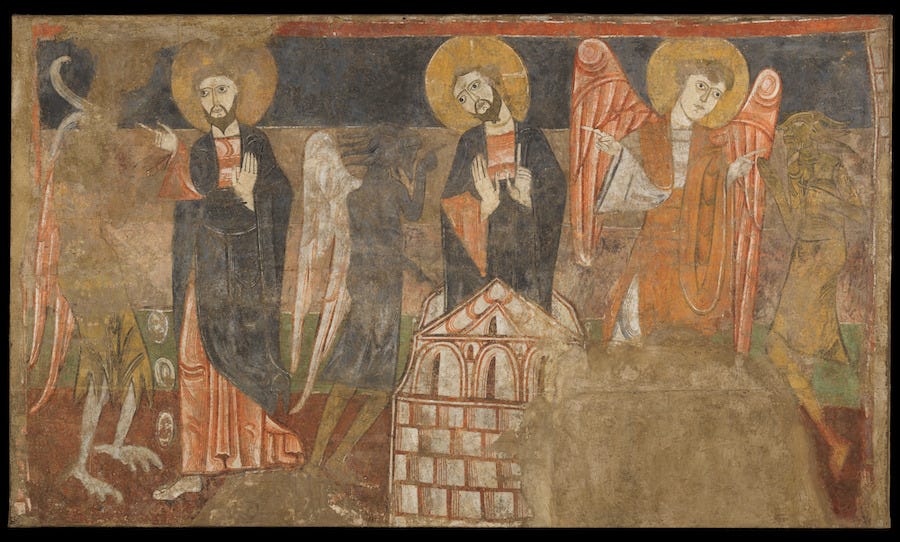
Maree Sobolewski on the dangers of “antisocial deception”: “As Christians, we are each accountable and responsible for our own as well as our government’s integrity. Jesus resisted the lies and temptations in the desert and named them for what they were. We are called to do the same.”