


Scroll down for our latest offerings this week, including:
“Deeper Assets,” our recent podcast episode with interspiritual pioneer Kurt Johnson
“Jesus and Diversity, Equality, and Inclusion” by Charlie Gibson
The major story in the US Catholic church this week was the release of the statement “Charting a Moral Vision of American Foreign Policy” co-authored by Cardinal Blase J. Cupich, archbishop of Chicago, Cardinal Robert McElroy, archbishop of Washington, and Cardinal Joseph W. Tobin, C.Ss.R., archbishop of Newark.
The statement comes in response to America’s turn to an overt neo-imperial foreign policy—“all gunboat and no diplomacy,” in the phrase of Fintan O’Toole—particularly in Venezuela and Greenland. While our military interventions used to be coded in the language of human rights throughout the Cold War and “war on terror” eras, the current administration has adopted the posture of brute force as expressed by White House advisor Stephen Miller on January 5: “We live in a world, in the real world . . . that is governed by strength, that is governed by force, that is governed by power. These are the iron laws of the world since the beginning of time.”
“The events in Venezuela, Ukraine and Greenland have raised basic questions about the use of military force and the meaning of peace,” the cardinals’ statement reads. “The sovereign rights of nations to self-determination appear all too fragile in a world of ever greater conflagrations. The balancing of national interest with the common good is being framed within starkly polarized terms.”
Both the fragility and the conflagration, and the glaring contradictions, of this foreign policy were on full display in the capture of Venezuelan president Nicholas Maduro. As constitutional law scholar David Cole pointed out, this operation—as well as the summary execution of at least 115 people in unprovoked boat strikes in the months leading up to the invasion—was a violation of multiple tenets of international law. It was also a violation of the US Constitution that grants Congress the sole authority to declare war, and the War Powers Resolution that requires the president to notify Congress before involving troops in hostilities.
The administration’s justification for dispensing of these legal guardrails was the claim that Maduro was smuggling drugs into the United States. “By the administration’s logic,” Cole counters, “Canada could start shooting Americans suspected of carrying drugs over the US–Canada border, or bomb buildings in the US that it claimed were being used to manufacture the drugs. Mexico could do the same with respect to American manufacturers of guns that are routinely used in gang violence, which kills many thousands of Mexicans each year.”
The real reason for the operation was made explicitly clear in President Trump’s remarks following Maduro’s capture on January 3: “We’re going to have our very large United States oil companies, the biggest anywhere in the world, go in, spend billions of dollars, fix the badly broken infrastructure, the oil infrastructure and start making money for the country.” What used to be the “quiet part”—that US business and military interests were intertwined, and that our commitments to freedom and democracy fluctuated at will depending on the compliance of our client states—was here said out loud. It is retroactively reinforced when we look back to Trump’s meeting with Saudi Crown Prince Mohammed bin Salman, leader of a country with notorious human rights abuses as documented by our own State Department, in November. Asked about the assassination of Washington Post journalist and legal permanent resident Jamal Khashoggi, which US intelligence has linked to the crown prince, Trump replied, “Things happen.” The two men had met to discuss a deal between the Saudis and Lockheed Martin for the sale of advanced F-35 fighter jets.
Reporting on Canadian Prime Minister Mark Carney’s speech at Davos this week, Slate contributor Fred Kaplan writes, “The prime minister’s main message was that the ‘rules-based international order,’ which has shaped world politics since the end of World War II, is dead—and not likely to be revived.” It is into this geopolitical breach, for which the image of the United States “running” Venezuela for an ill-defined time at an ill-defined distance serves as an ominous metaphor, that the cardinals’ statement lands. Commending Pope Leo for “outlining a truly moral foundation for international relations” and providing an “ethical compass for establishing the pathway for American foreign policy,” they speak to the root of Christian nonviolence:
As pastors and citizens, we embrace this vision for the establishment of a genuinely moral foreign policy for our nation. We seek to build a truly just and lasting peace, that peace which Jesus proclaimed in the Gospel. We renounce war as an instrument for narrow national interests and proclaim that military action must be seen only as a last resort in extreme situations, not a normal instrument of national policy. We seek a foreign policy that respects and advances the right to human life, religious liberty, and the enhancement of human dignity throughout the world[.]
Michael Centore
Editor, Tomorrow’s American Catholic
Deeper Assets with Kurt Johnson
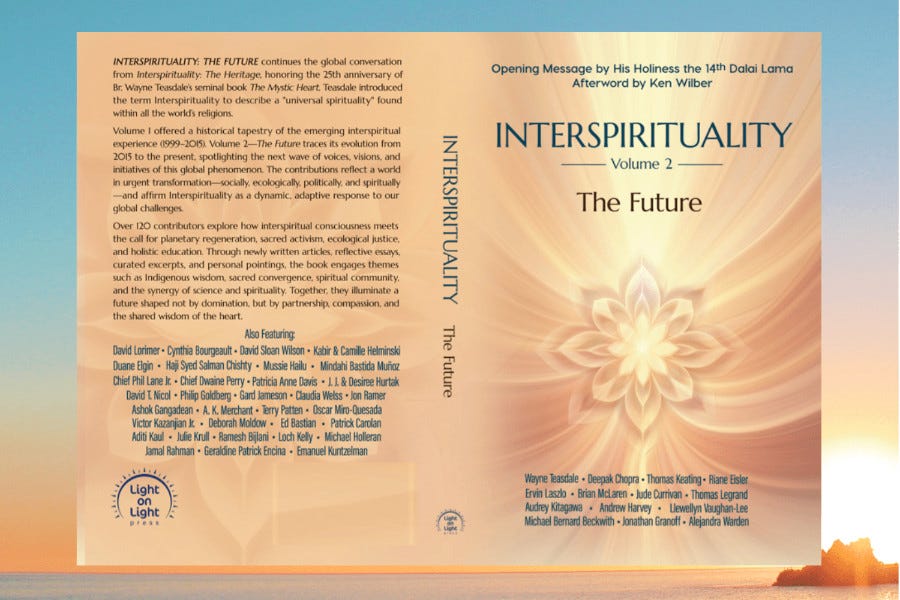
Kurt Johnson is an internationally renowned scientist, social activist, author, and former monastic. He is also a pioneer in the field of interspirituality, the discovery of a universal spirituality within the world’s religions. His latest project is the two-volume set Interspirituality (Light on Light Press), a compendium of writings on the heritage and future of the interspiritual movement with contributions from 120 religious and spiritual thought-leaders from all over the world. His Holiness the 14th Dalai Lama captures the essence of the volumes in his opening message: “Without a community, one single individual cannot survive. So we must develop a reality where the entire world of human beings are one human community—we are brothers and sisters—one humanity!”
In the latest episode of our podcast, we speak with Kurt about his (inter)spiritual background, the history and current state of the interspiritual movement, Catholic and Christian contributions to a “deep ecumenism,” and how we might “pilot out of a place of deeper assets” to build a better world.
Listen here »
Jesus and Diversity, Equality, and Inclusion
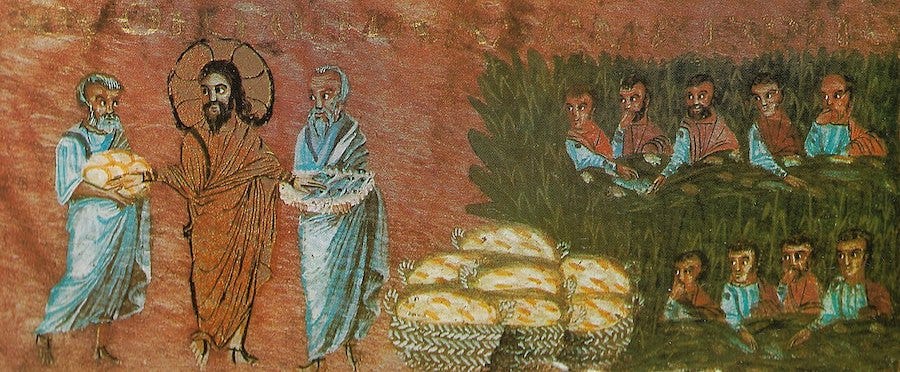
Charlie Gibson on Christ’s mission “to heal and cure, to free, to provide hope and freedom for the oppressed”: “What made Jesus so attractive to ordinary people, along with his ability to cure many physical and mental ills, was that he ‘walked his talk.’ This means that he showed not only by words but also by his behavior that he advocated and manifested diversity, equality, and inclusion.”
Read more »
Lessons from Amsterdam

Patrick Carolan on what sites of resistance from the Second World War can teach us today: “The Gies had three choices: they could become collaborators and report neighbors who were considered undesirable; they could, as many did, mind their own business and go about their daily lives; or they could actively oppose what was happening and try to help those who were being unjustly deported and executed. The Gies chose option three.”