


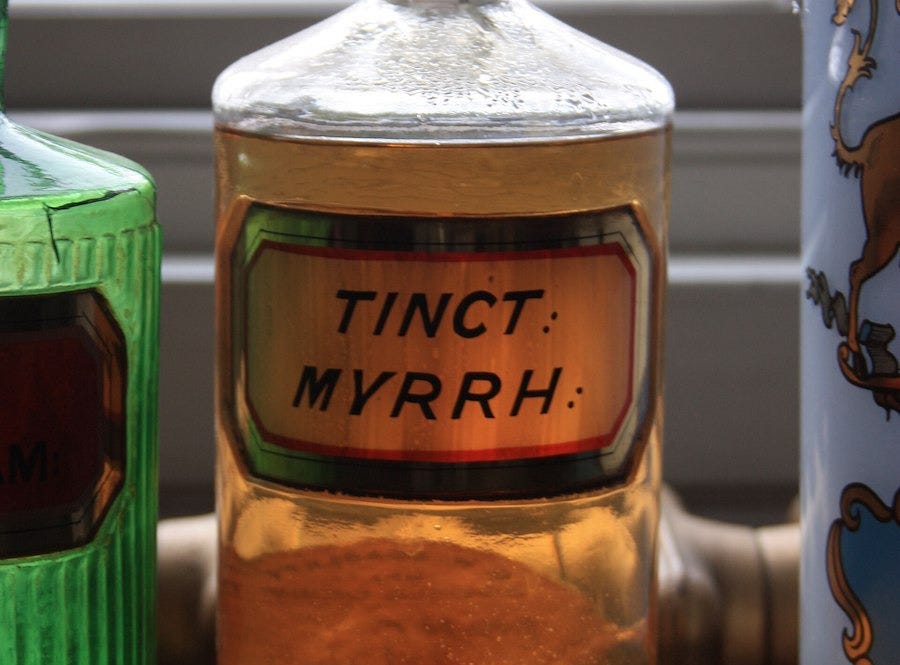
Though they do not appear in the Gospel of Mark, the writer of Matthew chooses to have similar figures to the anointing woman in Christ’s passion narrative: the three Magi, who appear during Christ’s birth narrative with the same type of ointment. The author of Matthew may have picked up on Mark’s use of anointment as a prophetic or messianic-initiating motif and chosen to introduce it at the moment when Jesus is born.
The Magi bring with them gifts of gold, frankincense, and myrrh (Matt 2:11). The Greek noun for myrrh is the same one used in the scene of the anointing woman in Mark 14:3-5. The Magi could here be seen to symbolically “baptize” Jesus into a life of messianic work. The role of the Magi is hidden within the context of the birth narrative; so, like the anointing woman, churches tend to trivialize their act, treating it as a sweet, sentimental gesture from those who knew that this was the birth of the Messiah and felt the need to bring gifts.
The anointing woman brought Jesus the same ointment when her action foretold his death as the Messiah. Just as she was initiating him into his messianic role upon his death, so the author of Matthew chose the Magi to initiate him into his messianic role upon his birth. Since it is evident that the writer of Matthew had a copy of Mark’s gospel with him as a source, the author could have attempted to round out that account by having the Magi at one end and the anointing woman at the other. Karen Jo Torjesen observes: “Like the prophet Samuel pouring oil over the head of the rough shepherd David, she lifted the vial over the head of the Galilean Jesus and poured her expensive ointment over his hair. As the prophet Samuel had identified David as the king of Israel, her symbolic action proclaimed Jesus publicly as the Son of David, the coming Messiah, Christ, the anointed one.”
In addition to Mary Magdalene and the anointing woman, two of the most noteworthy disciples are Syrophoenician woman and the hemorrhaging woman. These women, like the anointing woman, are anonymous in the Gospel of Mark. “The anonymity and relative invisibility of women in Mark is due in part to the androcentric bias of his culture which viewed women only in terms of their relation to men, usually as their mothers, wives, or daughters, except in instances of extraordinary importance,” writes Winsome Munro. Mary Ann Tolbert adds: “These anonymous ones illustrate the fertile ground which bears abundant fruit, and their anonymity, courage, generosity, and ministry, as well as their concrete healing, witness to their position among the fruitful elect of God’s kingdom.”
Neither the Syrophoenician woman nor the hemorrhaging woman is associated with a male figure, like Mary Magdalene and the anointing woman. The healing of the hemorrhaging woman is the only Markan healing that occurs without the expressed intent of Jesus, and the healing of the Syrophoenician woman’s daughter is the only Markan healing that occurs at a distance from Jesus. These two women are healed in their own right, each healing in its own way related to the transcending of the law. In many ways, they both have accomplished much more for themselves through their faith in Jesus than all the twelve male disciples.
Both Munro and Susan Lochrie Graham have highlighted the importance of these two women in relation to Jesus. For Graham, the hemorrhaging woman’s healing concerns menstrual uncleanness:
She has “suffered” for twelve years, a description used only of Jesus in this gospel (8:31; 9:12), and is the only character said to have suffered this way. She experiences her illness as a scourge, the same way in which Jesus predicts will happen to him (10:34); and like Jesus she is said to tell the truth (5:33; cf. 12:14, 32). The image of blood is related to suffering and to women’s inability to give birth during the twelve years. Like her, Jesus will suffer; unlike her, through his blood new life will come. In touching him, she is healed, that is, she takes on this new life, so that the image of death is infused with an image of new life. The exchange of the miracle is like no other. There is silence: no word is spoken aloud; there is only touch. The theology of touch is related to the Eucharist in Mark, for Jesus instructs his disciples to take and eat (14:22-25).
Healing this woman allows her to become an active member of her society, as Jesus has rendered her ritually clean again. The boundary between clean and unclean has been broken, and Jesus chooses not to chastise her for touching him but instead calls her “daughter.” Through her faith, she became a “daughter” or female disciple of Jesus.
The healing of the Syrophoenician’s daughter involves a heated debate between the woman and Jesus. The silence of the anointing woman and the hemorrhaging woman is not an issue here. Touch is no longer necessary when speech has taken its place, as Munro points out:
What is at issue in [Mark] 7:24-30 is not the female identify of the Syrophoenician, but that she is a Gentile. Nevertheless, to some extent she disturbs the more usual Markan pattern for Jesus’ encounters with women in that she comes from the outside into the privacy of a house to meet with Jesus. Even more, she is the only woman with whom Jesus engages in verbal sparring in Mark. She alone, in contrast to the worsted scribes, Pharisees, and Sadducees, has victory conceded to her, winning an apparent change of stance which brings about the healing of her daughter.
Graham gives further context: “Placed between the two feeding stories (6:35-44; 8:1-10), the interchange between Jesus and this woman reflects the imagery of nourishment, that which is literally given to both Jews and Gentiles in the loaves that are miraculously multiplied, and that which will figuratively be given in the body that is broken.” Thus we encounter another eucharistic metaphor aimed at a female disciple of faith who has successfully proven herself to be a worthy follower of Jesus.
The knowledge of the Good News through the resurrection and the unconditional clean faith within the heart of a person are, for the Jesus of the gospels, the marks of a true disciple. Mary Magdalene, the anointing woman, the hemorrhaging woman, and the Syrophoenician woman made wonderful disciples and apostles, spreading the Good News as they themselves believed and experienced it. To recognize this is not enough; but to invoke it through the acceptance of women in the clergy affirms that the women in the Gospel of Mark, and the parallel passages in the other canonical gospels, were witnesses to Christ’s mission, experiencing it more profoundly than Jesus’s chosen Twelve even if they did not partake of it equally.
Women are reading the gospels “against the grain” and voicing the silence of 2,000 years. There is really only one step left to take: Women must be granted the same opportunities as men in ecclesiastical ordination. Now is the time to read the canonical gospels as texts which can include women in the chain of apostolic succession. This would still be staying within our 2,000-year-old tradition—just merely expanding it. ♦
Dr. Sarita Melkon Maldjian is a professor of the Core and the English departments at Seton Hall University in South Orange, New Jersey. She is an advocate for Catholic school education and ordaining women in the Catholic, Orthodox, and Apostolic churches. She and her family are active members in the Armenian Apostolic Church, and all of her children have attended Catholic schools from pre-K through grade 12. She and her family are professional classical musicians and have performed all over the tri-state area. She holds her master’s degree in theology and doctorate degree in Biblical studies and music pedagogy from Drew University, Madison, New Jersey.