


This week’s newsletter reflection comes courtesy of David O’Brien, professor emeritus at the College of Holy Cross in Worcester, Massachusetts, and author, among other books, of Public Catholicism and Isaac Hecker: An American Catholic. David originally wrote the following as an email in response to last week’s newsletter, “Apostolic Competence,” and I thought it was such an incisive account that it was worth reprinting in full. Readers may recall the text of David’s Monsignor Hugh Crean Distinguished Memorial Lecture that we published in three parts (available here, here, and here) in 2023.
Below David’s reflection you’ll find this week’s offerings, including coverage of the Dorothy Day Guild’s recent webinar; our latest podcast with Fr. Reginald Norman, pastor of St. Mark Church in Stratford, Connecticut, and vicar of the Apostolate of Black Catholics for the Diocese of Bridgeport; and an article on re-understanding the sacraments of initiation.
For those interested, I’ve contributed the reflection on this week’s gospel for U.S. Catholic. The text and video are available here—M.C.
We in the United States had some Synod-like experiences in the years following the Second Vatican Council. They were interrupted for the most part, and it will be hard to get them up and running again, learning from our earlier experience as Pope Francis asked of us.
Nowhere is that need greater than in thinking about ordained ministry. To their great credit, the US bishops paid significant attention to priesthood following the council. Many American diocesan priests thought they were the “forgotten men” of the council. Bishops, laypeople, and religious orders of men and women all were given attention and emerged to respond to conciliar invitations to renewal and, maybe, some modest reforms.
But while priests obviously heard with approval calls to action on liturgy, shared responsibility, and social service, the only specific call to their ministry was to work more closely with one another and their bishop. Nevertheless, they responded enthusiastically to the council, preparing to present new liturgies and adjusting to communitarian messages about parish worship, education, social service, and even governance with new parish councils. Soon they were working with their bishops to organize “senates” of priests (later presbyteral councils) and considering whether they also needed their own independent “associations.” Some even toyed with forming unions.
Just a few years after the council, the Vatican decided that in 1971 the newly established Synod of Bishops from around the world would consider two subjects: justice in the world and the ordained ministry. To prepare for this event the American bishops commissioned five serious studies which produced published reports on the priesthood, one each on history, sociology, psychology, spirituality, and theology. They also surveyed the nation’s now somewhat organized clergy, asking what issues they thought the bishops attending the synod might consider.
The priests, speaking as pastors, listed the requirement of celibacy as the number one issue. As it turned out, the Vatican forbade discussion of celibacy and the American bishop-delegates did not bring it up. There was widespread disappointment back home, and before long Catholics were talking about a “crisis” as many prominent priests left their ministry—many with, some without, going through a formal process. Seminaries consolidated or closed, and it got harder and harder to find replacements for departing and retiring priests.
While many carried on in the spirit of the council, it would be fair to say that American diocesan priests never fully recovered. Newly ordained priests were often less interested in Vatican II–era ideas about renewal and were opposed to even modest efforts at reform. Then, beginning in 1984 and exploding in 2002, the clerical sex-abuse scandals and the closed-door, incompetent response of the bishops caused enormous damage to the solidarity of the ordained and the spirit of trust that once informed the life and work of the American church. Today, to consider ordained ministry without honest attention to this history is a formula for disappointment in the important efforts to develop a synodality of unity and shared responsibility in parishes, dioceses, and Catholic institutions.
To do better, the American hierarchy might start with three moves:
1) Decide to begin as they did after the council with their own obligation to work together to develop national policies of shared responsibility among themselves and with their priests, religious women and men, and their lay professionals, all working to develop synodal practices that draw laypeople, ecclesiastical public servants, and the ordained together to govern themselves.
2) Make pastoral care the central ministry of the ordained and the unifying, informing ministry of all members of the community; make it clear that in a free society pastoral ministry is the central ministry, and all ministry must have a pastoral dimension. We have to care for one another as we try as best we can to care for our neighbors, all of them. And pastoral care requires study, training, support, intelligence, and imagination if the US church is to continue to be what, at its best, it has always tried to be: “a community of faith and friendship,” in the words of Vatican II–era leader Cardinal John Dearden.
3) To show seriousness and initiate effective strategy, make an emergency effort to refashion the permanent diaconate as a lay vocation for women and men. When it was restarted after the council, many saw the diaconate as an office aimed at serving synodal solidarity by ensuring that there would be a lay voice within the worlds of the ordained and an ordained voice within the many worlds of the laity. If we have learned anything in our recent history, it is that as long as power is concentrated with the ordained it will be very hard to bring meaning to the lay worlds of work and learning and politics. The diaconate provides a way to invite to community service holy, experienced, older laywomen and laymen as lay leaders. Their place inside the ecclesial system is essential: They may be the only ones able to make the move toward synodality authentic and exciting.
Across the country and the world, divisions deepen, the powerful become ever more powerful, and good people retreat to personal devotions and private worlds of meaning and shared responsibilities. To speak of Americans as one people pledged to liberty and justice for all makes one a partisan; to speak of all of us as a single human family in danger of omnicide makes one sound like a fool. Synodality was Pope Francis’s vision that we Catholic Christians could change this historical trajectory if we would, together, honestly face the realities around us and address them as a community of faith and friendship, a beacon of light for everybody, everywhere. To bring that hope back to life will require a hard look at ourselves, beginning with truthfulness about clergy and hierarchy and power within the people of God. Let’s ask the Synod working group to go back to work.
David J. O’Brien
“The Ones Who Have Stayed”
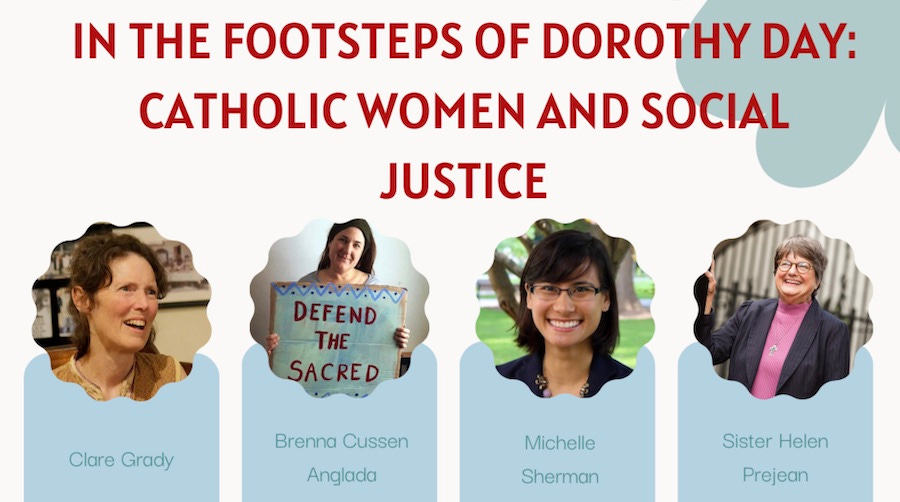
Held in honor of International Women’s Day on March 8, “In the Footsteps of Dorothy Day: Catholic Women and Social Justice” featured a panel of four women sharing how Dorothy and the Catholic Worker movement have shaped their activism: “Holding up a work of art depicting the women lamenting beneath the cross surrounded by portraits of female saints, Michelle Sherman said that one of her roles as program director for nonviolence and campus outreach at Pax Christi USA is ‘constantly reminding people in the church and outside of the church that women have been the ones who have stayed.’
“Women have always been a part of the ‘Jesus movement,’ she continued, referencing the Samaritan woman in the reading for the Third Sunday of Lent along with women who have served as ‘seeds of regeneration’ within the church for centuries, such as Mother Cabrini and Catherine of Siena.”
Read more »
Spirit to Spirit, Soul to Soul
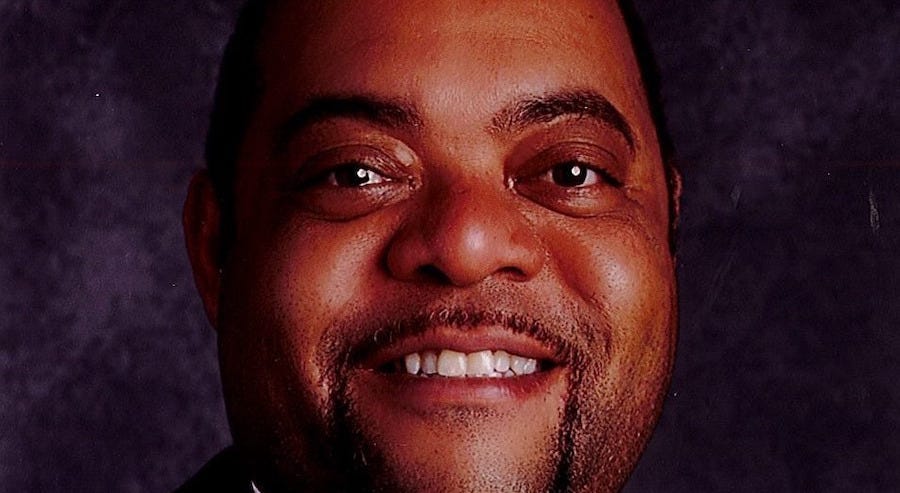
Fr. Reginald Norman was born in Durham, North Carolina, and raised in Connecticut. He converted to Catholicism in 1990 at St. James Roman Catholic Church in Stratford, Connecticut, and pursued a career in business before answering the call to priesthood. Ordained a priest for the Diocese of Bridgeport, he has served as pastor and administrator at multiple parishes and is presently the vicar of the Apostolate of Black Catholics, pastor of St. Mark Church in Stratford, Connecticut, and dean of the Seat of Wisdom Deanery.
In this episode, we speak with Fr. Reginald about his background in the Baptist tradition and entrance into the Catholic Church, forms of systemic racism that are still present in diocesan structures, and his perspective on the state of the Black Catholic movement in the church today. Fr. Reginald also shares with us the importance of surrender on the spiritual path, the difference between “dictating and disappearing” and “acting and assisting” in living out the church’s mission, and how “recognition of injustice is power, not punishment.”
In tandem with this episode, Fr. Reginald has kindly let us reproduce the text of his keynote speech given at the Stratford Interfaith Service honoring Dr. Martin Luther King Jr. this past January.
Listen here »
Baptism = Initiation
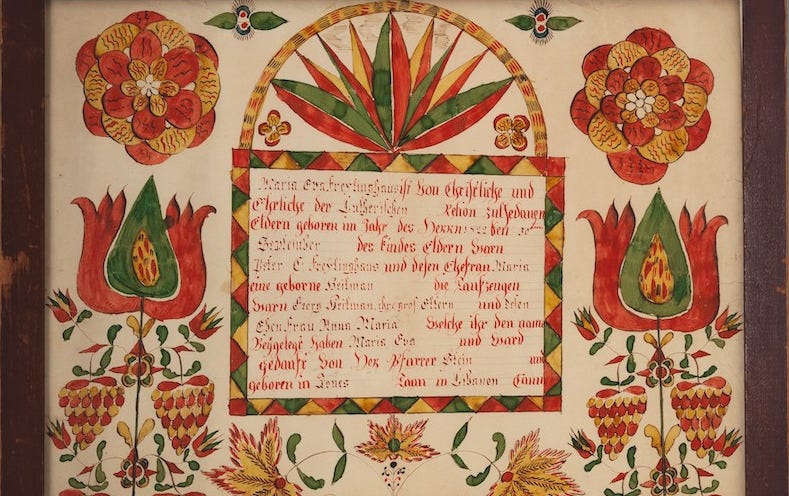
Beverly Brazauskas on understanding baptism as a welcoming into community: “At baptism, parents are asked to name two people who will provide support and love for the baby by their side. These people are called godparents. They are there to assist the mother and father in raising their child as a member of the church into which the baby is being baptized. Baptism is the first sacrament of initiation—again, initiation into what? The parents and godparents should be walking alongside these children, introducing them to the church of which they are members, being there when several years later they are invited to receive their First Communion.”
Wonderful article…as a woman who worked in the church for most of my adult life, I agree that it is high time for the church to look at ways to expand ordained ministry.