


Note: In order to complete the final details of our website transition, and to prepare new articles and podcast episodes for our planned relaunch in January, TAC will be taking a brief hiatus on publishing new work through January 5, 2026. We encourage readers to peruse our Archive in the meantime—we’ve included a few seasonally appropriate selections below. We wish everyone a blessed Advent-Christmas season and hopeful New Year, and look forward to sharing some exciting new work with you soon!
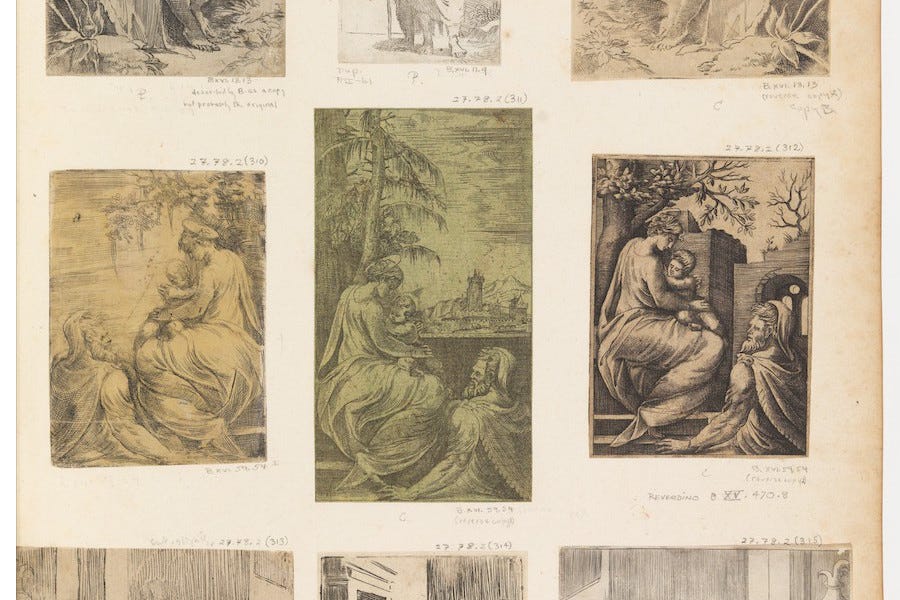
Two quotes that came out of an article on the controversial crèche displayed at St. Susanna Church in Dedham, Massachusetts, earlier this month merit further reflection.
The first is from a spokesperson for the Boston Archdiocese, St. Susanna’s jurisdictional home, who said: “The people of God have the right to expect that, when they come to church, they will encounter genuine opportunities for prayer and Catholic worship—not divisive political messaging.” The second is a statement from the executive director of the Catholic Action League of Massachusetts calling the crèche a “tawdry act of political grandstanding.’’
“[F]aithful Catholics of Dedham can now look forward to a traditional Nativity scene, reminding them, in joyous expectation, of the birth of Our Savior,” the statement reads, praising the archdiocese’s rebuke of a “dissident priest.”
The crèche in question removed the figures of the Holy Family and replaced them with a sign reading “ICE was here,” in reference to the mass deportation policies of the current administration. Earlier this year, the administration removed prohibitions on immigration raids in places of worship, resulting in arrests on or near church properties, including Catholic parishes. It was also reported that the US Department of Homeland Security planned to ramp up deportations during the holiday season—a decision promoted with a tawdry social media campaign that sought to normalize and even celebrate the presence of military-grade law enforcement on the streets of a republic—despite evidence showing that less than 30 percent of those arrested in recent raids held prior criminal convictions.
In a separate statement from December 11, the Catholic Action League links the issues of immigration and labor, arguing that “imported, low wage, illegal immigrant labor depresses the wages of American workers.” The statement invokes the names of Pope Leo XIII, Theodore Hesburgh, and Cesar Chavez to assert that “Even prominent Catholic voices, in the name of the just wage, opposed illegal immigration.”
It we take the claims of the League at face value and their concern for the working class in good faith, the problem is still in the framing: that this is somehow an either/or debate, that we can’t achieve a humane immigration policy and a fair and living wage, that the root of both isn’t somehow the scarcity mentality that results when too much power and too many resources are concentrated in the hands of too few.
Dreaming beyond this binary is where the language of faith comes in, and it is why it is so disappointing to read the quotes of the League and the Boston Archdiocese that seem to separate out adoration and salvation from the embodied life of discipleship. Adoration doesn’t occur in a vacuum, and soteriology implies an ethics, an orientation, a “putting on” the higher mind of Christ that moves from duality to oneness. It is the very thing we celebrate this Advent season, and to say that we can encounter “genuine opportunities for prayer and Catholic worship” without expecting to be challenged and thereby transformed by the “scandal of the incarnation” is to delimit both the celebration and the quality of our worship. It results in a “sacristy Christianity” that turns Christ from subject to object—a dangerous reversal, if we are serious about facilitating rather than inhibiting God’s movement in the world.
In fairness to the two figures quoted above, there are certainly times when Christ’s message—both that left in the residue of words in the gospels and the summary message of his birth, death, and resurrection—can feel anarchic, befuddling, untamable, hard. The temptation is always there to want to domesticate the message and to turn Christ into a kind of cultural talisman, a figure from whom we can expropriate joy without carrying our share of the burden.
In those moments it may be best to admit our limitations, which at least gives God something to work with, some seed of humility from which he can draw fruit. It also gives our adoration of the incarnation a deeper shading, as it shows us willing to pattern ourselves on Christ’s supreme humility: the moment when, in Cynthia Bourgeault’s physical description, “he implanted himself deeply at ground zero, at the root of the root of all density, in order to insulate us from its sting and empower us to live within our human flesh as he himself lived.”
Writing elsewhere of the incarnation, Bourgeault says, “The act of loving brings hidden potential to full expression, and the more intimate and costly the self-giving, the more precious the quality of love revealed.” That movement from potential to expression is the underground river that thrums beneath this liturgical season and daylights in next week’s Feast of the Nativity—when we learn, with the shepherds and the Magi, that worship is never static but wedded to the movement of human life.
Michael Centore
Editor, Tomorrow’s American Catholic
A Lover of Clarity
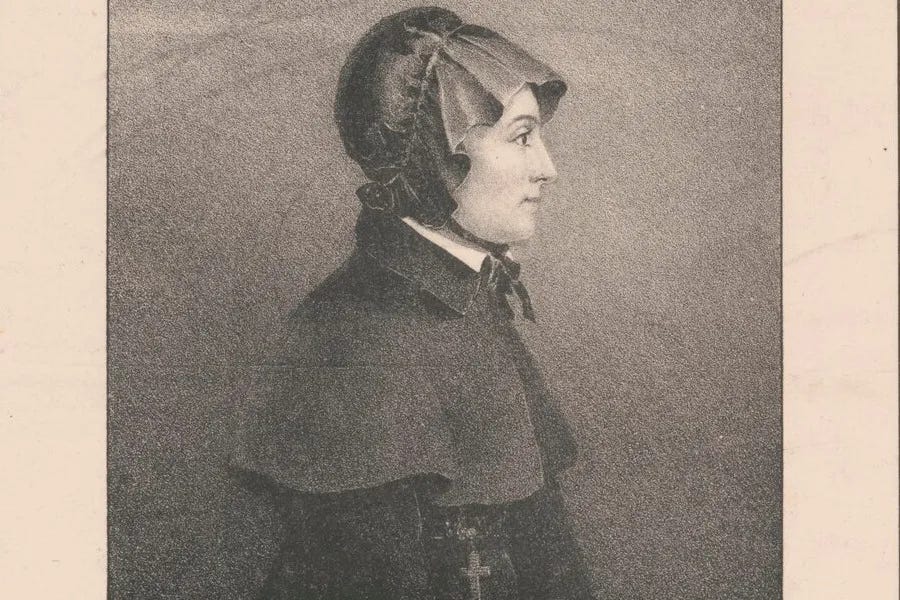
Angelina M. Medina and Dr. Sarita Melkon Maldjian on the 50th anniversary of the canonization of Elizabeth Ann Seton: “‘A lover of clarity felt the stir of mystery,’ Catherine O’Donnell writes, asserting that Seton’s spiritual path emerged from her authentic emotional expression. Seton vocalized her genuine feelings about fear, doubt, exhaustion, and loneliness through her numerous letters to family and friends. She used these emotions as the basis for prayer instead of attempting to conceal them. Through her authentic nature, Seton shows us that faith starts from the point of uncertainty, and does not simply bypass it.”
Read more »
“Expecting a Move from God”

Coverage of the Catholic organization Call to Action’s Advent reflection with executive director Black Moses Rankins: “Pivoting to the threat of Immigration and Customs Enforcement (ICE) raids across the country this Advent, Rankins said, ‘Our sisters and brothers are hiding.’
“‘As dark as the world is getting,’ both clergy and laypeople are ‘showing up’ for immigrants and other marginalized communities, he said. He referenced CTA members who are making ‘care packages’ for immigrants, saying, ‘There are efforts to make the world a better place.’
“‘I’m praying for transformation for all our American brothers and sisters,’ he added.”
Read more »
From Our Archives

As we work to categorize and sort our archives, we offer a selection of Advent-themed essays and reflections that have moved us over the years:
“The Pause before Our Fiat” by Fran Salone-Pelletier (December 2020)
“The Working Catholic: Advent, Part I” by William Droel (November 2021)
“The Working Catholic: Advent, Part II” by William Droel (December 2021)
“May Dew Descend Like Heaven” by Michael Ford (December 2021)
“The Human Deed: An Advent Meditation” by Edward R. Burns (December 2021)